Unit I · Vasai Phata Production Floor

Precision Sheet Metal Stamping, Pressing & Power Press Job Work Vasai · Mumbai · Palghar

20 Hydraulic & Mechanical Presses · 10T to 150T · Progressive Die, Compound Die & Deep Draw · ISO 9001:2015 · Since 1989

Aero Enterprises Unit I, Vasai Phata operates one of the most machine-dense power press stamping floors in the Mumbai–Palghar industrial corridor — 20 hydraulic and mechanical presses from 10T to 150T running progressive die, compound die, and deep drawing sheet metal stamping operations for LED lighting, automotive, solar tracker, furniture, and stationery OEMs. ISO 9001:2015 certified sheet metal stamping services with in-house die maintenance, first-off inspection, and integrated powder coat finishing at Unit I, Vasai, Maharashtra.

Unit I · FabricationSurvey No. 109, Richard Compound, Vasai Phata, Vasai East, Palghar 401208
Unit II · Steel SupplyDhumal Nagar, Vasai East, Palghar 401208
ISO 9001:2015  ·  MSME Registered  ·  JSW & TATA Stockist

Expertise and Experience

Aero Enterprises Unit I Vasai Phata operates one of the most densely equipped power press stamping floors in the Mumbai industrial corridor. With 20 hydraulic and mechanical presses ranging from 10 to 150 tonnes, we run progressive die, compound die, deep drawing, blanking, and piercing operations simultaneously across multiple client jobs in a single shift. Our stamping division serves LED lighting manufacturers, automotive OEMs, tracker OEMs, furniture manufacturers, stationery manufacturers, and precision sheet metal component clients who require consistent geometry, maintained tooling, and high-volume output without dimensional drift across the batch.

Why Our Process Wins

With 20 active power presses on a single production floor at Unit I, Aero Enterprises allocates press tonnage to each job based on material grade, thickness, and die force requirement rather than press availability. This tonnage-matching protocol eliminates under-forming and over-forming errors that produce dimensional variation across high-volume batches. In-house die maintenance ensures that tooling geometry is verified and corrected between production runs, not after a batch rejection.

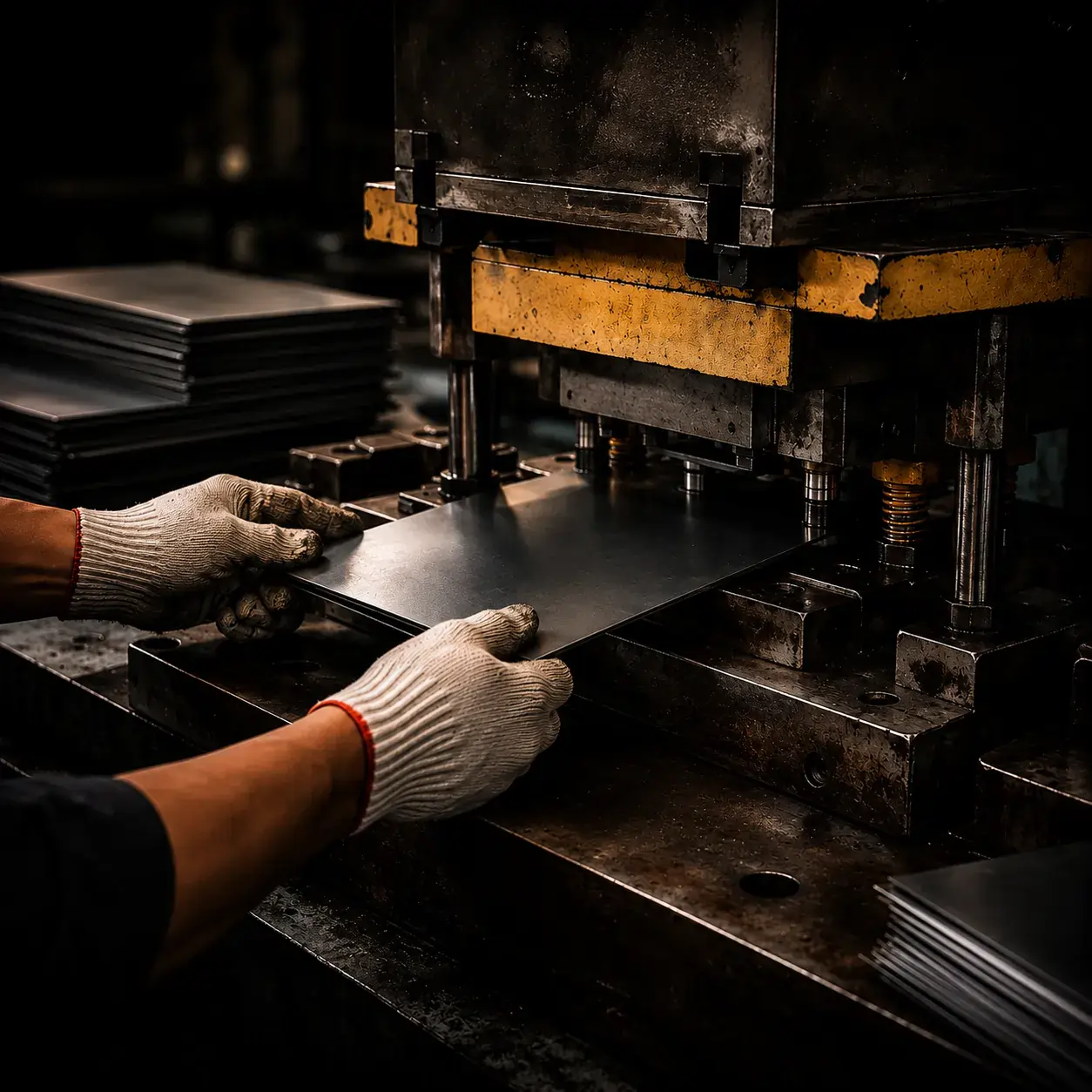
20-press power press stamping floor at Aero Enterprises Unit I Vasai Phata
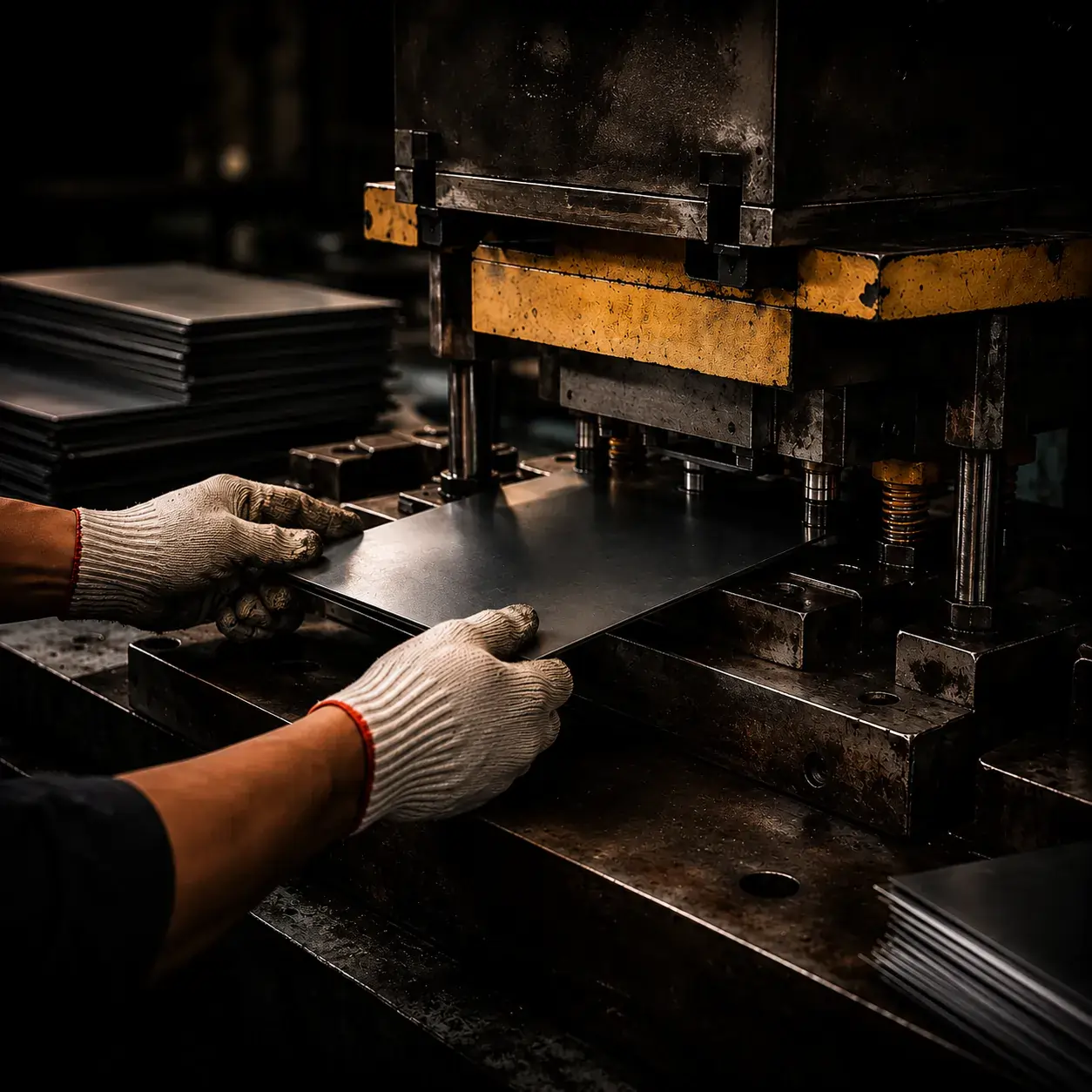
150T hydraulic power press deep drawing operation at Aero Enterprises Unit I
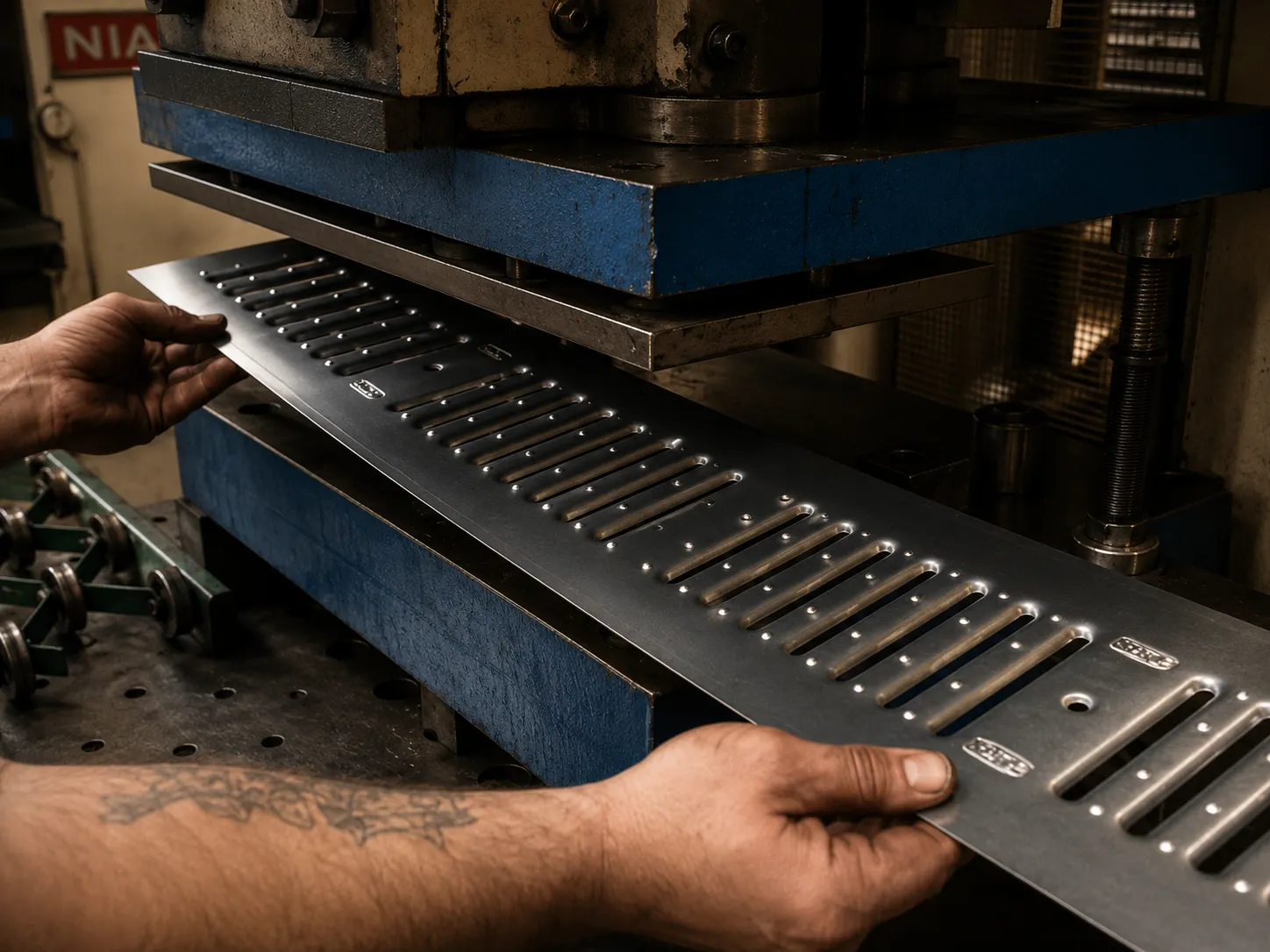
Stamped sheet metal components under first-off dimensional inspection at Unit I Vasai
Total Press Count
20 Power Presses
Press Capacity Range
10T to 150T
Press Fleet Breakdown
150T ×1, 100T ×1, 75T ×1, 60T ×1, 50T ×2, 30T ×2, 20T ×6, 10T ×7
Dimensional Tolerance
±0.05mm to ±0.1mm
Material Capability
CR IS 513 (CQ/DQ/DDQ), HR IS 2062, GI IS 277, SS 304/316, Brass, Copper
Material Thickness Range
0.5mm to 6.0mm
Max Stroke Speed
60–100 Strokes/Min (Mechanical), Programmable (Hydraulic)
Die Types Operated
Progressive, Compound, Deep Draw, Form, Restrike
Coil Feed Capability
Continuous coil-fed production on progressive die operations
Tooling
In-house die fabrication, maintenance and calibration

Machinery · Unit I Vasai Phata

150T Hydraulic Press ×1, 100T Power Press ×1, 75T Power Press ×1, 60T Power Press ×1, 50T Power Press ×2, 30T Power Press ×2, 20T Power Press ×6, 10T Power Press ×7. Total: 20 Active Power Presses at Unit I Vasai Phata.

Core Capabilities

Progressive Die Stamping: Multi-station coil-fed operations producing net-shape components with all holes, slots, and formed features complete in a single continuous press cycle. Correct for high-volume repeat components above 500 pieces per order where batch consistency is a specification requirement.
Compound Die Stamping: Simultaneous blanking and piercing in a single press stroke for medium-volume components where progressive tooling investment is not justified but dimensional consistency across the batch is required.
Deep Drawing Quality (DDQ) Processing: Severe draw ratio forming of CR IS 513 DDQ grade sheet for enclosure bases, lighting housing shells, and drawn cup geometries. Die geometry and press force control are matched to the specific draw ratio to prevent wall thinning, fracture, and earing defects.
Precision Blanking and Piercing: Net-shape blank production and internal hole and slot piercing with punch-to-die clearance maintained at 10 to 12 percent of material thickness per side for clean sheared edge condition and consistent hole diameter across the full production batch.
Forming and Embossing: Stiffening rib formation, logo embossing, and locating feature forming on flat sheet components using matched form dies at Unit I.
Compound Bending and Restrike Operations: Secondary restrike and re-forming operations to correct springback, improve angular accuracy, and achieve tight-tolerance profiles that single-stroke forming cannot produce.
In-House Tool Design, Maintenance and Calibration: All progressive, compound, and form dies are maintained at Unit I. First-off dimensional verification is performed at the start of every production run. Worn tooling is identified by burr height monitoring and punch-to-die clearance measurement and replaced before batch quality is compromised.

Verification Protocol

First-off dimensional inspection on all critical dimensions including hole pattern, blank profile, formed feature geometry, and overall component envelope before batch production is approved. Performed using calibrated digital calipers, height gauges, and profile templates against the approved drawing.

Hourly in-process batch sampling for gauge consistency, burr height monitoring, and hole diameter verification throughout the production run. Sampling frequency increases on worn tooling indicators.

Punch-to-die clearance measurement at defined intervals. Tooling approaching the upper clearance limit is replaced before the batch quality threshold is reached, not after a rejection event.

First-off banner verification on compound bending operations using calibrated angle gauges before batch bending begins.

Final surface integrity and dimensional audit on finished batch before transfer to powder coat or dispatch. Includes edge condition check, emboss depth check on form operations, and coating adhesion pre-check on degreased surfaces.

At Unit I · Vasai Phata

Stamping Operations

Six stamping and forming operations run simultaneously across the 20-press floor. Each has a correct application — specifying the wrong operation produces defects that cannot be corrected downstream.

sheet metal blanking

Blanking

Cutting a net-shape flat blank from sheet or coil. The blanked piece is the product; the surrounding skeleton is scrap. Blank profile tolerance ±0.1mm at Unit I. Used as the first operation before all downstream forming, bending, and welding stages.

Applications

Mounting plates · Enclosure panels · Structural hardware blanks · Bracket profiles

piercing in sheet metal

Piercing

Producing internal holes, slots, and cutouts in sheet metal components. The punched slug is scrap; the component retains the hole. Punch-to-die clearance maintained at 10–12% per side for a clean sheared edge and consistent hole diameter across the full production batch.

Applications

Bolt hole patterns · Ventilation slots · Fastener clearances · Locating features

punching operation in sheet metal

Punching

The broad stamping category covering all operations where a sheet metal punching machine forces a punch through material to remove it. The punching process in sheet metal at Unit I handles 0.5mm to 6.0mm thickness across 20 presses from 10T to 150T — press tonnage matched per job.

Applications

Perforated panels · Hardware components · High-volume bracket production · Strip blanks

deep drawing sheet metal

Deep Drawing

Forming a flat blank into a 3D cup, box, or enclosure shell by pressing it into a die cavity. A part is classified as deep drawn when its depth exceeds its diameter. Requires CR IS 513 DDQ grade. Press force, blank holder pressure, die radius, and punch radius are matched to each draw ratio to prevent wall thinning, fracture, and earing defects.

Applications

LED housing shells · Enclosure bases · Drawn cup geometries · Lighting bodies

sheet metal embossing

Embossing

Creating raised or recessed features on sheet metal without cutting through the material. The embossing operation in sheet metal displaces material using matched form dies. The embossing process in sheet metal at Unit I produces stiffening ribs, identification logos, locating pads, and anti-slip surface patterns on flat components.

Applications

Stiffening ribs · Logo marking · Locating pads · Panel reinforcement · Anti-slip features

notching in sheet metal

Notching

Removing material from sheet metal corners or edges before bending to allow clean flanged corners without material overlap at the fold. Notching in sheet metal is performed on box sections, frame profiles, and multi-flange bracket blanks before bending at Unit I.

Applications

Box corners · Frame sections · Folded enclosures · Multi-flange brackets · Panel tabs

Which Process Is Right For You?

Progressive vs Compound
vs Deep Draw Die

Die type determines per-part cost, tooling investment, and achievable tolerance. Wrong die type for the volume produces either over-investment or inadequate batch consistency.

High Volume — ≥500 pcs

Progressive Die

SpeedFastest — continuous coil fed
Feed MethodCoil strip, automated advance
Tool CostHigh — amortises at volume
Accuracy±0.1mm

Best For

LED hardware, automotive brackets, stationery components, high-volume repeat production

Medium Volume — 100–500 pcs

Compound Die

SpeedMedium — single stroke
Feed MethodIndividual pre-cut blanks
Tool CostMedium
Accuracy±0.05mm — flattest blanks

Best For

Precision flat blanks, mounting plates, enclosure panels, hole-pattern-critical components

3D Geometry — Any Volume

Deep Draw Die

SpeedControlled draw speed
Feed MethodPre-cut circular or profiled blank
Tool CostHigh — geometry specific
AccuracyDraw ratio controlled

Best For

LED housing shells, enclosure bases, drawn cups — CR IS 513 DDQ grade mandatory

Power Press Machine Types

Mechanical vs Hydraulic Power Press

Both types run at Unit I. Press type is allocated per job — not by availability.

Mechanical Power Press

Flywheel and crankshaft delivers fixed-energy, high-speed stroke. Energy stored in flywheel is released at each stroke cycle.

Stroke Speed

60–100 strokes/min

Best For

High-volume thin-gauge blanking, piercing, and punching where cycle speed is the primary production variable

At Unit I Vasai Phata

10T to 60T at Unit I — 10T ×7, 20T ×6, 30T ×2, 60T ×1

Hydraulic Power Press

Hydraulic pressure delivers programmable and controllable force at any point across the full stroke length. Force is adjustable mid-stroke.

Stroke Speed

Programmable — full rated force available at any stroke position

Best For

Deep drawing, thick structural forming, and operations where blank holder force control is critical to prevent fracture or wall thinning

At Unit I Vasai Phata

75T to 150T at Unit I — 75T ×1, 100T ×1, 150T ×1

How Aero Enterprises Allocates Press Type

Press tonnage and type are matched to each job based on material grade, thickness, die type, and forming requirement. A client does not specify the press — Aero Enterprises production engineering allocates the correct machine before the job is scheduled.

Manufacturing ID · Unit I Vasai Phata

Unit I Capability

150T Hydraulic Press ×1, 100T Power Press ×1, 75T Power Press ×1, 60T Power Press ×1, 50T Power Press ×2, 30T Power Press ×2, 20T Power Press ×6, 10T Power Press ×7. Total: 20 Active Power Presses at Unit I Vasai Phata.

Full Machinery Inventory

Industries Served

Industrial Applications

All Sector Capabilities
01

LED Lighting Manufacturers

Housing shells, heat sink brackets, driver enclosures, and mounting hardware for LED flood light, street light, and panel light assemblies.

02

Tracker OEMs

Structural brackets, pivot hardware, mounting plates, and formed section components for solar tracker systems requiring high-volume consistent geometry.

03

Automotive OEMs

Chassis brackets, body reinforcement components, mounting plates, and drawn cup parts in DDQ grade CR for Tier-1 and Tier-2 automotive supply chain clients.

04

Furniture Manufacturers

Wall unit brackets, folder hardware, hinge reinforcement plates, and formed steel components for modular office and industrial furniture systems.

05

Stationery Manufacturers

High-volume precision stamped hardware components, binding mechanism parts, and formed strip components for stationery assembly operations.

06

Sheet Metal Component and Parts Clients

Custom-specified precision stamped components for industrial assembly, electrical enclosures, HVAC support hardware, and general engineering applications.

People Also Ask

Precision Sheet Metal Stamping and Pressing | Aero Enterprises VasaiTechnical FAQ

Common technical and commercial questions about precision sheet metal stamping and pressing | aero enterprises vasai at Aero Enterprises Unit I, Vasai Phata.

What are power presses used for in sheet metal fabrication?

Power presses are used for sheet metal stamping operations including blanking, piercing, punching, embossing, deep drawing, notching, coining, and forming. A power press applies controlled force through a die set to deform, cut, or shape sheet metal into precise components. At Aero Enterprises Unit I, 20 power presses from 10T to 150T run progressive die, compound die, and deep draw stamping operations for LED lighting, automotive, solar tracker, furniture, and stationery OEM clients across Vasai, Mumbai, Thane, and Palghar.

What is the difference between mechanical and hydraulic power press stamping?

A mechanical power press uses a flywheel and crankshaft mechanism to deliver a fixed-energy, high-speed stroke at 60 to 100 strokes per minute — correct for high-volume thin-gauge blanking and piercing. A hydraulic power press delivers programmable force at controlled speed across the full stroke — correct for deep drawing, thick material forming, and operations requiring blank holder force control. At Aero Enterprises Unit I, mechanical presses cover 10T to 60T and hydraulic presses cover 75T to 150T, with press type allocated per job based on operation type, material, and tonnage requirement.

What is progressive die stamping and when should I use it?

Progressive die stamping uses coil-fed sheet metal strip advancing through multiple die stations with each press stroke. Each station performs one or more operations — blanking, piercing, forming, bending — until the completed component exits the final station. Progressive die stamping is correct for components above 500 pieces per order where per-piece cycle time must be minimised and batch dimensional consistency is a specification requirement. Tooling investment is higher than compound or single-stage dies but amortises at high-volume production scale.

What is the difference between progressive die and compound die stamping?

Progressive die stamping performs multiple operations sequentially across multiple stations as the strip advances — correct for high volume and complex multi-feature components. Compound die stamping performs blanking and piercing simultaneously in a single press stroke at one station — producing flatter, more dimensionally accurate blanks. Compound die is correct for 100 to 500 piece volumes where progressive tooling investment is not justified but dimensional consistency on the blank profile and hole pattern is required.

What is deep drawing in sheet metal and what material grade is required?

Deep drawing is a sheet metal forming operation that produces a 3D cup, box, or enclosure shell from a flat blank by pressing into a die cavity using a punch. The process is classified as deep drawing when the formed depth exceeds the part diameter. At Aero Enterprises Unit I, CR IS 513 DDQ (Deep Drawing Quality) grade is mandatory for deep drawing operations. Standard CQ or DQ grade will fracture or develop wall thinning at deep draw ratios. DDQ grade has a controlled microstructure specifically for severe plastic deformation without failure.

What sheet metal materials can be stamped at Aero Enterprises?

Aero Enterprises Unit I stamps CR IS 513 (CQ, DQ, DDQ grades), HR IS 2062, GI IS 277, SS 304, SS 316, aluminium, brass, and copper across a material thickness range of 0.5mm to 6.0mm. Grade is reviewed per operation type — DDQ grade is mandatory for deep drawing, DQ for tight-radius forming, CQ for standard blanking and piercing. All material enters production from JSW and TATA primary certified coils verified against Mill Test Certificates at Unit II Dhumal Nagar.

What dimensional tolerances does power press stamping achieve?

Power press stamping at Aero Enterprises Unit I achieves ±0.05mm to ±0.1mm on blank profile, hole diameter, and hole pattern centre-to-centre spacing. Punch-to-die clearance is maintained at 10–12% of material thickness per side for clean sheared edges and consistent hole geometry. First-off dimensional inspection using calibrated digital calipers, height gauges, and profile templates is performed on all critical dimensions before batch production is approved on every job.

What causes burr in sheet metal stamping and how does Aero Enterprises control it?

Burr in sheet metal stamping is caused by excessive punch-to-die clearance or worn tooling. When clearance exceeds 12% per side, metal tears rather than shears cleanly, producing a raised burr on the exit face that fails downstream assembly and coating processes. At Aero Enterprises Unit I, burr height is monitored during hourly in-process batch sampling. Punch-to-die clearance is measured at defined intervals and tooling is replaced before the quality threshold is exceeded — not after a client rejection.

What is the minimum order quantity for sheet metal stamping at Aero Enterprises?

Aero Enterprises Unit I processes stamping orders from 100 pieces for compound die and single-stage operations. Progressive die stamping is economical from 500 pieces upward where tooling investment amortises across the production run. For prototype and design validation requirements, 3000W fiber laser cutting at Unit I produces first-off samples from DXF files on the same production day — without any tooling cost — allowing geometry confirmation before die investment is committed.

When should I use sheet metal stamping instead of fiber laser cutting?

Sheet metal stamping is more economical than laser cutting above a volume threshold — typically 300 to 500 pieces for compound die and 500+ pieces for progressive die. Stamping also produces 3D formed features including embossing, deep drawing, notching, and restrike that laser cutting cannot. Laser cutting is correct for prototypes, short runs below 200 pieces, and complex profiles where die tooling investment is not justified by volume. At Aero Enterprises Unit I, both processes run on the same floor and the correct process is allocated per job based on volume, geometry, and total unit cost.

Have a Technical Question Not Listed Here?

Contact our engineering desk directly. We respond with technical specifics, not sales language.

Contact Engineering Desk
Engineering Knowledge Base

Technical Guides
for Precision Sheet Metal Stamping and Pressing | Aero Enterprises Vasai

2026-03-03

From Flat Sheet Metal to Precision Component: How Aero Enterprises Does It

A flat sheet of mild steel sitting in the stockyard at Aero Enterprises Unit II Dhumal Nagar has no value to a client. The value is created at Unit I Vasai Phata, where that sheet goes through a defined sequence of power press stamping, CNC bending, and punching operations to become a finished precision component that fits a specific assembly, carries a specific load, and meets a specific dimensional tolerance. That transformation is not a series of independent steps. It is a production system. Understanding how that system works, what each process contributes, and where the failure points are is the difference between a client who gets consistent precision parts and one who gets consistent rejections.

Read Guide

2026-03-03

Flood Light Mounting Bracket Manufacturing: Sheet Metal Fabrication Guide

A flood light mounting bracket is one of the most mechanically stressed components in any outdoor lighting installation. It carries the full dead weight of the fixture, absorbs wind load continuously, and sits exposed to UV, rain, and coastal salt air for a service life measured in decades. Most procurement decisions for flood light brackets are made on price per piece. The correct decision is made on material grade, coating system, bend geometry, and fabrication process. A bracket that fails at 18 months in an outdoor installation is not a cheap bracket. It is an expensive one.

Read Guide

2026-03-15

L Patti Manufacturing: How Steel Corner Brackets for Furniture Are Made

An L patti is one of the most structurally critical components in a wooden furniture assembly and one of the most consistently under-specified. Furniture manufacturers across India source corner brackets on unit price alone, without specifying sheet thickness, hole pattern accuracy, bend radius, or coating system. The result is brackets that deform under joint load, loosen at 12 months, and generate warranty returns that cost multiples of the original hardware saving. At Aero Enterprises Unit I Vasai Phata, L patti corner brackets are manufactured as precision stamped and powder coated structural hardware, not as commodity press shop output.

Read Guide

2026-03-03

How Saddle Pipe Clamps Are Made Using Power Press Stamping

A saddle pipe clamp looks like one of the simplest components in any building or industrial installation. A U-shape bend, two mounting holes, a painted or galvanized finish. Most procurement decisions treat it exactly that way, a commodity item bought on price per piece with no specification depth. That approach works until a clamp deforms under pipe weight, corrodes through at 18 months in a wet riser shaft, or pulls away from the wall because the mounting hole punched undersized for the fastener. At Aero Enterprises Unit I Vasai Phata, saddle pipe clamps are not treated as commodity stampings. They are treated as structural hardware components where the die geometry, material grade, hole pattern accuracy, and coating system determine whether the clamp performs for 10 years or fails at 18 months.

Read Guide

2026-03-03

Wall Unit Folder Bracket Manufacturing: Sheet Metal Stamping Guide

A wall unit folder bracket is one of those components that nobody thinks about until it fails. It carries the static weight of loaded document folders every day, takes repeated dynamic loading every time a folder is removed or replaced, and sits on a wall unit that may be moved, reinstalled, and reconfigured multiple times over its service life. Most buying decisions for folder brackets are made on unit price alone. The correct decision is made on sheet thickness, die geometry, mounting hole pattern, and powder coat system. A bracket that deforms at 6 months or whose coating chalks off in a year is not a cost saving. It is a replacement cost plus downtime.

Read Guide

Request a Quote for Precision Sheet Metal Stamping and Pressing | Aero Enterprises Vasai

JSW and TATA certified steel at Unit II. Full fabrication sequence — stamping, bending, welding, powder coat — at Unit I. No subcontracting. No vendor handoffs.

Mill Test Certificates (MTC) Available Upon Request