Home/All Services/Fiber Laser Cutting
Unit I: Vasai Phata Production Floor

Fiber Laser Cutting

3000W Fiber Laser Cutting: Nitrogen and Oxygen Assist, Six Material Grades, ±0.1mm Tolerance

Expertise and Experience

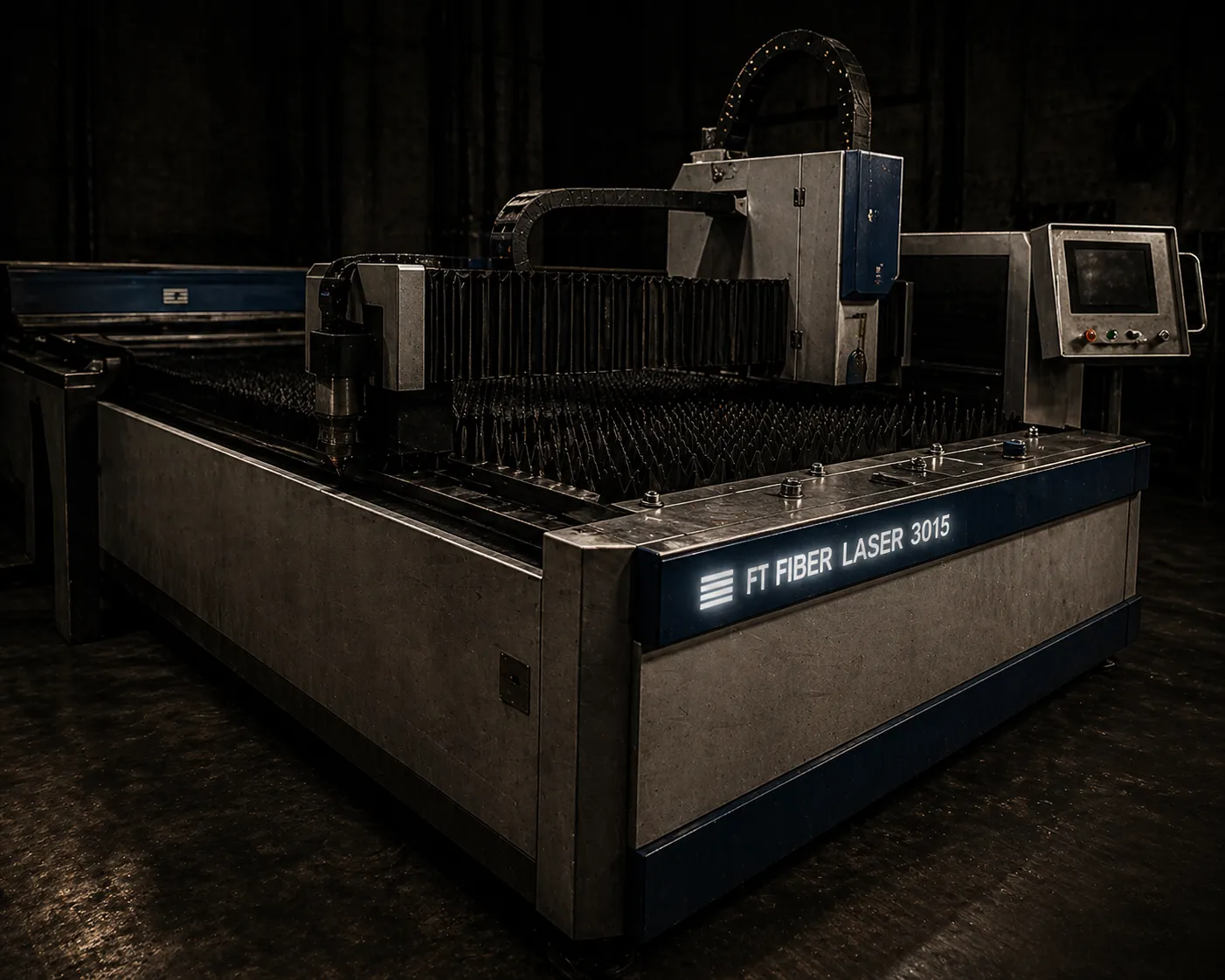
Aero Enterprises Unit I Vasai Phata operates a 3000W CNC fiber laser cutting system on a 1500x3000mm working bed with dual assist gas capability: nitrogen for oxide-free edges on components going directly to powder coat or cosmetic finishing, and oxygen for high-speed cutting on structural mild steel where edge appearance is secondary to throughput. The fiber laser cuts MS IS 2062, GI IS 277, SS 304 and 316, aluminium, brass, and copper to a positional tolerance of plus or minus 0.1mm. Maximum cutting thickness is 20mm on mild steel. This is not a standalone laser cutting service. It is the first production stage in Aero Enterprises' integrated fabrication sequence at Unit I, where laser-cut blanks feed directly into stamping presses, CNC press brake bending, welding, and powder coat finishing on the same floor. Clients who source laser cutting through Aero Enterprises are not managing a separate cutting vendor and a separate fabrication vendor. They are working with one integrated production system where the cut blank is produced to the specification of every downstream process it will pass through.

Why Our Process Wins

The most expensive laser cutting mistake is not made at the machine. It is made at the file submission stage. A PDF drawing instead of a DXF file, missing kerf compensation, holes smaller than material thickness, or no assist gas specification relative to the downstream coating process produces parts that are dimensionally off, have oxide edges that reject powder coat, or have holes that deform on bending. At Aero Enterprises Unit I, every laser cutting job goes through a DFM file review before the sheet is loaded. Kerf compensation is confirmed, minimum hole diameter is checked against material thickness, assist gas is specified based on the downstream process, and nesting is optimised for material yield before cutting begins. This review eliminates the most common laser cutting failure modes before a single pierce cycle runs.

Laser Source
3000W Fiber Laser
Max Sheet Size
1500 x 3000mm
Cutting Tolerance
±0.1mm Positional
Max Thickness MS
20mm
Max Thickness SS
8mm (Nitrogen Assist)
Max Thickness Aluminium
10mm
Max Thickness GI
6mm
Max Thickness Brass / Copper
4mm
Assist Gas
Nitrogen (Oxide-Free Edge) and Oxygen (High-Speed MS)
Material Capability
MS IS 2062, GI IS 277, SS 304, SS 316, Aluminium, Brass, Copper
Minimum Hole Diameter
Equal to or greater than material thickness
Kerf Width
0.2 to 0.3mm (material and thickness dependent)
File Format
DXF preferred. CAD/CAM nesting and kerf compensation applied at Unit I
Nesting
Automated CAD/CAM nesting, 10 to 15 percent material waste target

Machinery at Unit I Vasai Phata

3000W CNC Fiber Laser Cutting System, 1500x3000mm Working Bed, Dual Assist Gas: Nitrogen and Oxygen, Automated CAD/CAM Nesting Software. Integrated with CNC Press Brake, Power Press Floor, Welding, and 7-Tank Powder Coat Line at Unit I Vasai Phata.

Full Machinery Inventory

Core Capabilities

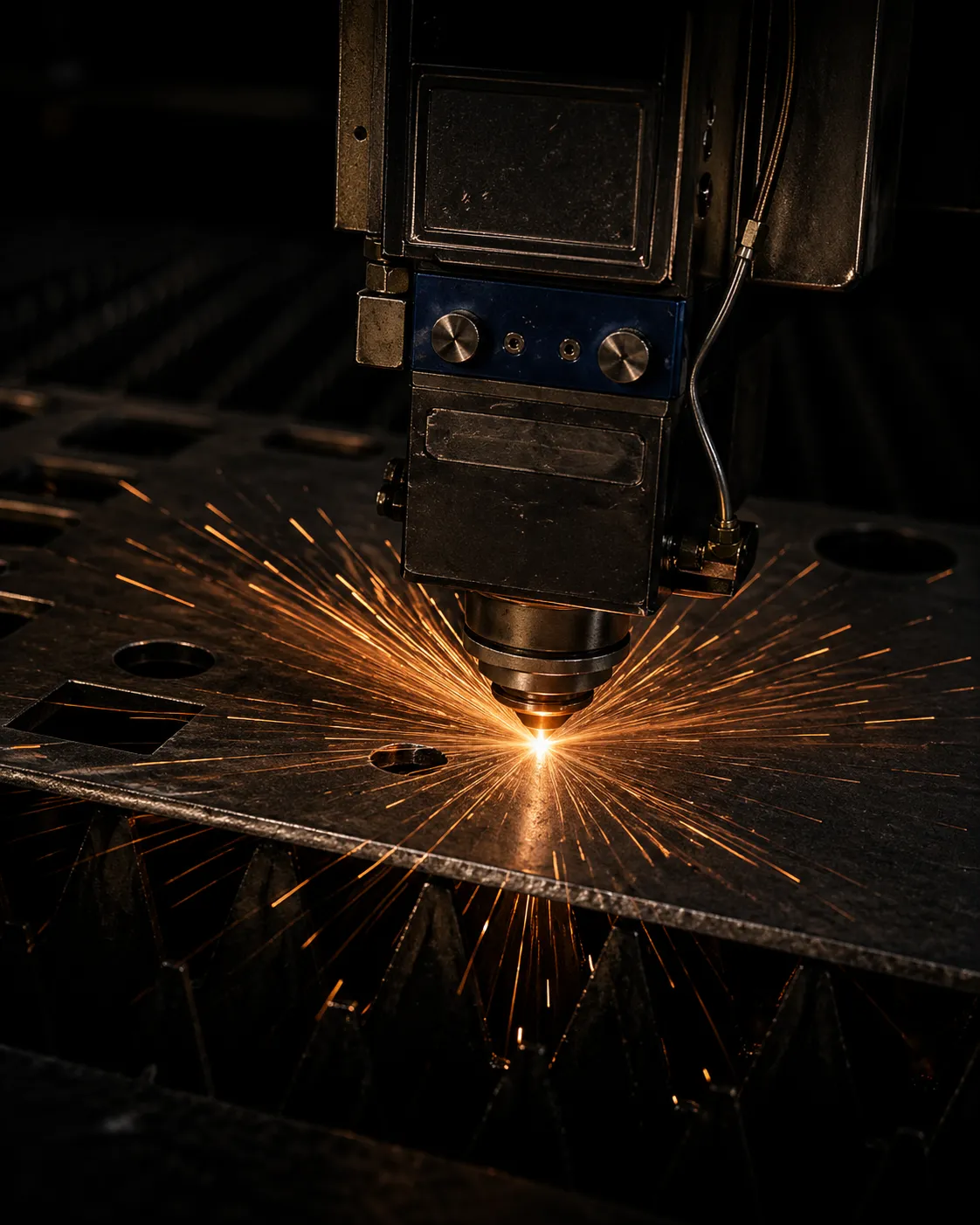
High-Speed Fiber Laser Profiling: 3000W fiber laser source cutting complex profiles, internal cutouts, slots, perforations, and net-shape blanks to plus or minus 0.1mm positional tolerance on a 1500x3000mm working bed. Fiber laser wavelength at 1.06 microns is absorbed significantly more efficiently by metals than CO2 at 10.6 microns, producing faster cutting speeds at equivalent power on all sheet metal thicknesses below 20mm.
Nitrogen-Assist Cutting for Oxide-Free Edges: Nitrogen assist gas delivered coaxially through the cutting nozzle produces a bright, oxide-free cut edge suitable for direct powder coat or paint application without additional edge preparation. Mandatory specification for stainless steel to prevent chromium oxide formation at the cut edge, and the correct specification for any MS or GI component going directly to powder coat finishing at Unit I without intermediate grinding.
Oxygen-Assist Cutting for High-Speed Structural Work: Oxygen assist gas exploits the exothermic reaction between oxygen and hot mild steel to increase cutting speed by 20 to 30 percent on MS above 3mm compared to nitrogen assist. Correct specification for structural MS components going to welding assembly where cut edge oxidation is not a coating adhesion concern. Aero Enterprises selects assist gas based on the downstream process for every job, not by default.
CAD/CAM Automated Nesting: All laser cutting jobs at Unit I are nested using CAD/CAM nesting software that arranges part profiles on the 1500x3000mm sheet to minimise skeleton scrap and offcut waste. Optimised nesting reduces material waste from 30 to 40 percent on manually arranged sheets to 10 to 15 percent. At current Mumbai MS and CR mill pricing, this waste reduction translates directly to lower material cost per part for the client.
Micro-Joint Nesting for Small Component Batches: Small components and hardware parts are nested with micro-joint tabs that hold cut parts in the sheet skeleton during cutting, preventing part movement and tip-up that causes collision with the cutting head on thin gauge material. Micro-joints are broken manually after cutting and the small witness marks are dressed before downstream processing.
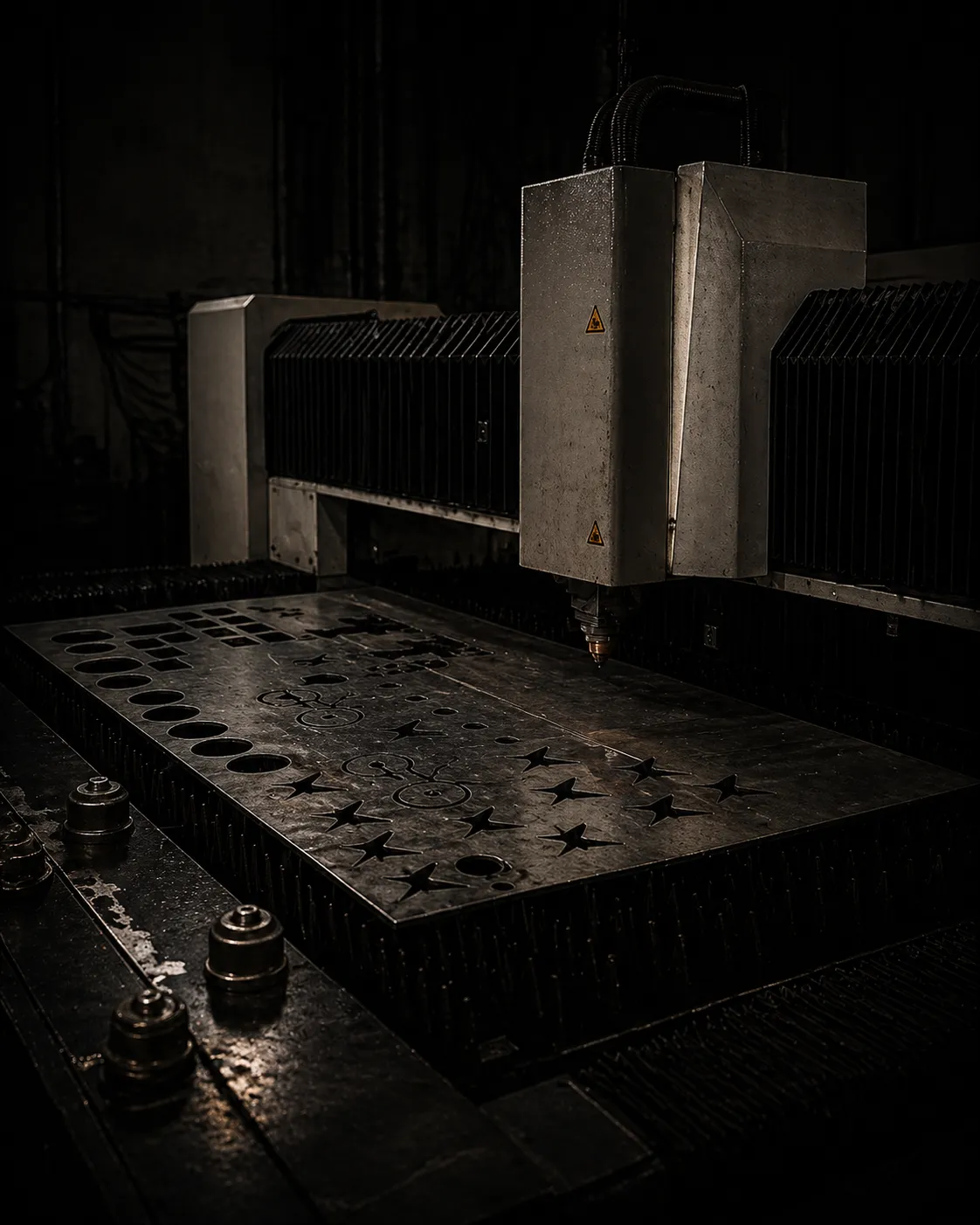
Complex Geometric Perforation and Internal Cutouts: Ventilation patterns, louvre arrays, decorative perforations, and complex internal cutout geometries that cannot be produced by mechanical shearing or turret punching are within the fiber laser's capability at Unit I. Minimum internal feature size is limited by the kerf width of approximately 0.2 to 0.3mm at standard production thicknesses.
Rapid Prototype and Short-Run Production: New component geometries can be cut from DXF file to first physical part within the same production day at Unit I without tooling investment or setup cost. This makes fiber laser cutting the correct process for prototype development, design validation, and short-run production before progressive die tooling is committed for high-volume stamping.
Integrated Downstream Processing: Laser-cut blanks at Unit I feed directly into the CNC press brake bending program, stamping press operations, MIG and TIG welding stations, and the 7-tank powder coat pre-treatment line on the same production floor. No external transport, no batch handoff, no inter-vendor communication delay between cutting and downstream fabrication stages.

Verification Protocol

DFM file review on every new job before sheet is loaded. DXF file is checked for minimum hole diameter compliance against material thickness, kerf compensation status, feature spacing adequacy, and assist gas specification relative to downstream process. Jobs failing DFM review are returned with specific correction notes before cutting begins.

CAD/CAM nesting verification confirming part quantity, orientation, grain direction where specified, and micro-joint placement before the cutting program is approved and the sheet is loaded onto the cutting bed.

First-off dimensional check on all critical dimensions including hole pattern centre-to-centre, profile envelope, internal cutout position, and overall blank dimensions before full sheet batch is cut. Performed using calibrated digital calipers and coordinate measurement against the DXF reference geometry.

Edge burr and dross inspection on first-off and batch samples. Dross on the exit face of the cut indicates incorrect cutting parameters for the material and thickness being processed. Any dross formation triggers parameter adjustment before the batch proceeds.

Assist gas verification confirming correct gas type is active before cutting begins on each job. Nitrogen and oxygen lines are clearly labelled and the active gas is confirmed on the machine controller display before the first pierce cycle.

Dimensional coordinate check on complex profiles and hole patterns using calibrated measurement against DXF reference geometry. Positional deviation outside plus or minus 0.1mm on any critical dimension triggers machine recalibration before the batch continues.

36 Years of Fabrication Experience

ISO 9001:2015 certified. JSW and TATA primary mill partner. Serving LED lighting, tracker OEM, automotive, furniture, and stationery sectors.

Manufacturing ID

Unit I Capability

Machinery Deployment: 3000W CNC Fiber Laser Cutting System, 1500x3000mm Working Bed, Dual Assist Gas: Nitrogen and Oxygen, Automated CAD/CAM Nesting Software. Integrated with CNC Press Brake, Power Press Floor, Welding, and 7-Tank Powder Coat Line at Unit I Vasai Phata.. Managed within our primary production hub in Vasai Phata.

View Full Machinery Inventory
Vertical Integration

Industrial Applications

LED Lighting Manufacturers: Housing profile blanks, heat sink fin patterns, driver compartment cutouts, and mounting bracket blanks for LED flood light, street light, highbay, and panel light assemblies requiring tight dimensional tolerance and oxide-free edges for direct powder coat application.Tracker OEMs: Structural bracket profiles, mounting plate blanks, slotted adjustment plates, and formed section blanks for solar tracker systems requiring consistent hole pattern accuracy and clean cut edges for bolt assembly.Automotive OEMs: Precision bracket blanks, reinforcement plate profiles, body component blanks, and complex cutout geometries for Tier-1 and Tier-2 automotive supply chain components requiring plus or minus 0.1mm positional tolerance.Furniture Manufacturers: Panel profiles, decorative perforation patterns, bracket blanks, and wall unit component profiles for modular office and industrial furniture systems requiring consistent geometry across medium to high volume production batches.Stationery Manufacturers: Precision small-format component blanks, mechanism housing profiles, and formed strip blanks for stationery assembly operations requiring tight dimensional tolerance on small feature geometries.Sheet Metal Component and Parts Clients: Custom profile cutting, prototype development, short-run component production, and net-shape blank supply for industrial enclosures, electrical panels, HVAC support components, and general engineering fabrication across the full material capability range at Unit I.
All Sector Capabilities
Technical Deep-Dive

The Engineering Guide to sheet metal laser cutting complete guide

Master the technical variables and procurement standards for Fiber Laser Cutting with our engineering team's comprehensive guide.

Aero Enterprises Production Infrastructure

20 Power Presses · 3000W Fiber Laser · 7-Tank Powder Coat · ISO 9001:2015

Request a Quote for Fiber Laser Cutting

Consolidate your sourcing and fabrication with a single partner. JSW and TATA certified steel at Unit II. Full fabrication sequence at Unit I. No subcontracting.

Mill Test Certificates (MTC) Available Upon Request