From Flat Sheet Metal to Precision Component: How Aero Enterprises Does It
A flat sheet of mild steel sitting in the stockyard at Aero Enterprises Unit II Dhumal Nagar has no value to a client. The value is created at Unit I Vasai Phata, where that sheet goes through a defined sequence of power press stamping, CNC bending, and punching operations to become a finished precision component that fits a specific assembly, carries a specific load, and meets a specific dimensional tolerance. That transformation is not a series of independent steps. It is a production system. Understanding how that system works, what each process contributes, and where the failure points are is the difference between a client who gets consistent precision parts and one who gets consistent rejections.
Aero Enterprises Desk
Power press stamping, CNC multi-axis bending, punching operations, and precision sheet metal fabrication for automotive, HVAC, and industrial OEM clients
“Content compiled directly from active production operations at Aero Enterprises Unit I Vasai Phata, where hydraulic power presses, CNC press brakes, and punching operations process JSW and TATA certified primary coils into finished precision components for clients across the Mumbai, Thane, and Palghar industrial belt. 36 years of floor-level fabrication experience underpins every process described here.”
Last Reviewed: 2026-03-03
Direct Answer
Aero Enterprises converts flat sheet metal into precision components at Unit I Vasai Phata through a four-stage production sequence: power press stamping to produce net-shape blanks and formed features, CNC multi-axis press brake bending to achieve precise angle geometry, punching to produce holes and internal cutouts, and surface finishing through automated powder coat. Each stage is process-controlled and dimensionally verified before the next stage begins.
Quick Summary
- Aero Enterprises processes raw JSW and TATA certified sheet coil at Unit II into precision components at Unit I through stamping, bending, and punching
- Power press stamping at Unit I handles high-volume component production with hydraulic presses using progressive and compound dies
- CNC press brake bending at Unit I achieves plus or minus 0.5 degree angle repeatability on a 3100mm bed
- Punching produces holes, slots, and internal features with consistent edge quality across high-volume batches
- The sequence of processes is determined at DFM review before production begins, not improvised at the machine
- Every stage is dimensionally verified before the next stage begins, preventing compounding errors through the production sequence
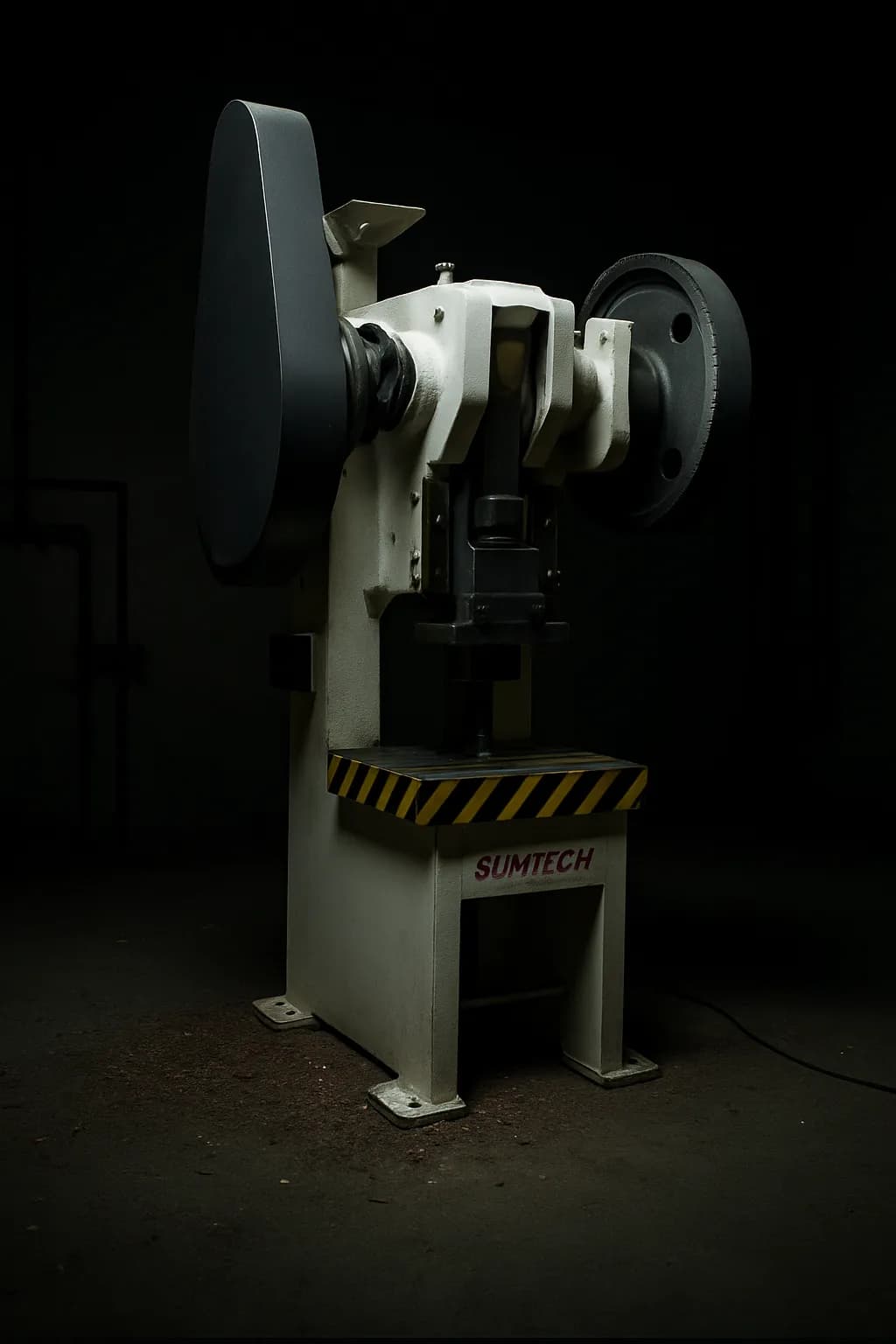
How a Flat Sheet Becomes a Precision Component at Aero Enterprises Unit I
Every component produced at Aero Enterprises Unit I Vasai Phata starts at the same point: a flat sheet or coil strip of mill-certified CR IS 513 or HR IS 2062 sourced directly from JSW or TATA through our Unit II Dhumal Nagar stockyard. From that starting point, the component follows a production sequence that is determined entirely by its geometry, tolerance requirements, material grade, and downstream assembly requirements. There is no standard sequence that applies to every part. A bracket for an automotive OEM with a tight hole pattern tolerance and a visible powder coat surface follows a different sequence to a structural frame member for an industrial enclosure going to site unpainted. What is consistent across every job is this: the sequence is decided at DFM review before the sheet is cut, every stage is dimensionally verified before the next stage begins, and no stage is treated as a correction opportunity for an error made in the previous one. At Aero Enterprises, precision is built in at each process step. It is not inspected in at the end.
Technical Insight
The most common source of dimensional failure in multi-stage sheet metal fabrication is not individual process inaccuracy. It is compounding error across the sequence. A blank that is 0.3mm oversized on one edge produces a bend that is 0.3mm out of position, which produces a hole pattern that is 0.3mm off nominal on the finished part. The finished part fails inspection and is rejected. The error originated at the blanking stage but was not caught until final inspection. At Aero Enterprises Unit I, first-off dimensional verification at each stage is not a quality procedure. It is a production economics decision. Catching a 0.3mm blanking error before 500 pieces go through three more process stages costs one rejection. Catching it at final inspection costs 500 rejections and a full rework or scrap cycle.
Why It Matters
Clients who source precision sheet metal components from Aero Enterprises are not buying individual stamping, bending, or punching operations. They are buying a controlled production system where the sequence is designed for their component geometry, every stage is verified, and the finished part matches the drawing the first time. This is what 36 years of floor-level fabrication experience at Unit I produces. Not just machine access, but a production system that eliminates the failure modes that generate rework, rejections, and delivery delays.
Stage One: Raw Material Intake at Aero Enterprises Unit II Dhumal Nagar
The precision of a finished component is constrained by the quality of the raw material it starts from. At Aero Enterprises Unit II Dhumal Nagar, incoming JSW and TATA certified coils and sheets are received against Mill Test Certificates that confirm grade, thickness, tensile strength, yield strength, and chemical composition. These are not administrative documents. They are the material baseline against which every downstream process is calibrated. A coil certified at 1.5mm CR IS 513 CQ with a specified tensile strength range is processed on press tooling designed for that material specification. Substituting an uncertified secondary coil of nominal 1.5mm that is actually 1.35mm in some sections introduces thickness variation that changes the press force required, changes the springback angle after bending, and changes the hole clearance in punching. These variations do not produce obvious visual defects. They produce parts that are within visual tolerance but outside dimensional tolerance, which fail at assembly. Unit II's certified weighbridge and material verification process ensures that what leaves the stockyard for Unit I is exactly what the production program specifies. This is not a supplier quality procedure. It is the first process step in component precision.
Stage Two: Power Press Stamping at Aero Enterprises Unit I
Power press stamping at Aero Enterprises Unit I uses hydraulic presses to apply controlled force through hardened tool steel dies to produce net-shape blanks, formed features, embossed patterns, drawn cups, and compound geometries from flat sheet or coil strip in a single press stroke or progressive multi-station die sequence. The hydraulic press at Unit I provides controllable tonnage across the full stroke, which is the correct press type for components requiring consistent forming force across varying cross-section depths, such as drawn enclosure bases, reinforced bracket profiles, and compound-form hardware components. Progressive die stamping at Unit I feeds a coil strip through a sequence of die stations, each performing one operation, so that a finished net-shape blank exits the final station complete with all holes, slots, formed features, and profile geometry in a single continuous press cycle. This is the correct process for high-volume components above 300 pieces per order where geometry consistency across the batch is a specification requirement rather than a target. Single-stage compound die stamping at Unit I performs blanking and piercing simultaneously in one press stroke, correct for medium-volume components where progressive tooling investment is not justified but batch consistency is still required. The die geometry for every component produced at Unit I is maintained in-house, which means geometry modifications between production runs are executed without external tooling lead time or cost.
Stage Three: CNC Multi-Axis Press Brake Bending at Aero Enterprises Unit I
After blanking and initial stamping, components requiring angular profiles, flanges, channels, boxes, or complex multi-bend geometries move to the CNC press brake at Aero Enterprises Unit I. The press brake at Unit I operates a 3100mm working bed length with a CNC back gauge system that positions the sheet against a calibrated mechanical stop before each bend stroke. This produces bend angle repeatability of plus or minus 0.5 degrees across the full bed length, which is the correct tolerance for precision enclosure fabrication, bracket profiles, and automotive components requiring consistent angular geometry across high-volume batches. Bending sequence is critical and is programmed into the CNC controller before the first piece is formed. On components with multiple bends, the sequence determines which flanges are formed first to maintain back gauge accessibility for subsequent bends. A wrongly sequenced bend program produces a component that requires the operator to rotate and reposition the blank between strokes without back gauge registration, introducing angular variation that accumulates through the sequence. At Aero Enterprises Unit I, bending programs are verified on a first-off piece against the drawing using a calibrated angle gauge and profile template before batch production is approved. Springback compensation for CR IS 513 at each thickness is built into the bend program as a material-specific offset, not estimated by the operator at the machine.
Stage Four: Punching Operations at Aero Enterprises Unit I
Punching at Aero Enterprises Unit I produces holes, slots, rectangular cutouts, louvres, and ventilation apertures in sheet metal components using hardened punch and die sets mounted in the press. The punching process shears the sheet material between the punch face and the die edge, producing a clean-edged hole with a controlled burr condition on the exit face. Punch-to-die clearance is the critical variable in punching quality. The correct clearance for CR IS 513 at 1.5mm is 10 to 12 percent of material thickness per side, which is 0.075 to 0.09mm total clearance. Below this clearance, the punch and die edges shear the material twice, producing a secondary shear zone and a rough, torn hole edge. Above this clearance, the material bends into the die opening before shearing, producing a rolled-over entry edge and excessive exit burr. Both conditions produce holes that fail dimensional inspection and create coating adhesion problems at the hole edge perimeter. At Unit I, punch and die sets are maintained to specified clearances and inspected at defined intervals. Worn tooling is identified by increasing burr height on production samples and replaced before the clearance exceeds the acceptable range. Punching is used at Unit I for components where hole quantity, pattern density, or internal cutout geometry makes laser cutting less cost-effective. For components requiring holes in formed sections after bending, punching in the flat blank before bending is the correct sequence wherever the bend geometry permits, because punching in the flat produces better hole geometry and edge condition than punching through a formed section with die clearance variation due to material springback.
Stage Five: Deburring and Edge Finishing at Aero Enterprises Unit I
Every sheet metal component that has been stamped or punched at Aero Enterprises Unit I carries sheared edges with burrs. Burr height on a well-maintained die is 0.05 to 0.10mm for CR IS 513 at standard production thicknesses. This is sharp enough to create laceration risk for assembly operators and enough edge irregularity to produce thin coating spots at burr tips that fail corrosion resistance in service. Deburring at Unit I is performed through vibratory tumbling for batch components such as brackets and hardware, and through manual bench deburring with edge breaking files for larger structural components where tumbling is not practical. All components are inspected for edge condition after deburring and before entering the powder coat line. The edge breaking operation that chamfers punched hole perimeters and blank outer edges to a consistent 0.2 to 0.3mm chamfer is not an optional cosmetic step. It is a coating adhesion requirement. Powder coat builds uniformly on a chamfered edge. On a sharp sheared edge without chamfer, the electrostatic powder coat process produces a thin spot at the edge apex due to the electric field concentration effect, which is called Faraday cage effect on inside corners and edge thinning on outside sharp edges. This thin spot is the first location where coating fails under corrosion exposure.
Stage Six: Automated Powder Coat Finishing at Aero Enterprises Unit I
Completed, deburred components at Aero Enterprises Unit I enter the automated powder coat conveyor line as the final production stage. The powder coat process at Unit I is a full three-stage system. Stage one is alkaline degreasing and water rinse to remove all stamping lubricants, oils, and surface contamination from the base metal. Stage two is zinc phosphate or iron phosphate conversion coating, which converts the clean CR steel surface to a crystalline phosphate structure that provides mechanical and chemical adhesion for the subsequent powder coat layer. Stage three is electrostatic powder application and oven cure at 180 to 200 degrees Celsius for 20 minutes, producing a crosslinked polyester coating at 60 to 80 microns dry film thickness on flat faces and minimum 50 microns on inside bend radii and punched hole edges. Dry film thickness is measured on every production batch using a calibrated magnetic thickness gauge on a minimum of 10 measurement points per component across flat faces, bend radii, and hole edges. Batches that fail minimum thickness on inside radii are stripped and recoated before dispatch. The colour and gloss level are matched to the client-specified RAL standard on a colour-calibrated reference panel for every batch. Aero Enterprises does not dispatch batches with colour variation against the reference panel, because colour inconsistency between delivery batches creates assembly and installation problems for clients producing finished products.
How the Process Sequence Is Determined: DFM Review at Aero Enterprises
The production sequence for any component manufactured at Aero Enterprises Unit I is not decided at the machine by the operator. It is decided at DFM review before the first sheet is cut. DFM review at Aero Enterprises covers six parameters for every new component. First, material grade and thickness adequacy for the application load and surface finish requirement. Second, blank geometry optimisation for nesting efficiency to minimise material waste at Unit II. Third, stamping die selection or design requirement for the component geometry and production volume. Fourth, bending sequence programming to ensure all bends are accessible to the CNC back gauge in the correct order. Fifth, punching sequence relative to bending, confirming whether holes are punched before or after forming based on geometry access and tolerance requirements. Sixth, coating system specification based on the installation environment and surface performance requirement. This review takes 30 to 60 minutes for a new component. It eliminates the most common production failure modes before a single sheet enters the press. Components that skip DFM review and go directly to production produce the full range of avoidable failures: wrong material, wrong sequence, compounding dimensional error, coating failure at edges, and batch rejections at final inspection. At Aero Enterprises, DFM review is the first production step, not an optional pre-production service.
Market Reality
The most expensive statement a fabrication client can make is this: just cut and bend it to the drawing. This statement assumes that a drawing fully defines the production sequence, the material specification, the die requirements, the bending program, the punching sequence, and the coating system. It never does. A drawing defines the finished geometry. It does not define the process path to get there. Clients who arrive at Aero Enterprises Unit I with a drawing and no process context get a DFM review before any production commitment is made, because a quote generated without that context is a guess, and a guess that wins the order creates a rework problem that costs the client time and Aero Enterprises reputation. The fabrication industry in Mumbai is full of job shops that will take a drawing, put it on the press without review, and ship whatever comes out. The rejections and rework costs that result are absorbed by the client and attributed to the fabricator. Aero Enterprises does not operate that way. The DFM review is not a delay. It is the step that ensures the first batch is the correct batch.
At Aero Enterprises Unit I Vasai Phata, the production floor processes HR, CR, and GI in the same shift on multiple machines simultaneously. The stamping presses run progressive and compound dies on the same day. The CNC press brake runs enclosure box bends in the morning and structural bracket sequences in the afternoon. The powder coat conveyor processes cosmetic-finish office hardware and industrial structural components in the same batch run when colour permits. This is possible because the process sequence for every active job is defined before it reaches the floor, not figured out at the machine. The 36 years of fabrication experience at Aero Enterprises is not a marketing line. It is the accumulated process knowledge that makes DFM review fast, bending program setup fast, die selection accurate, and first-off acceptance rates high. Clients who work with Aero Enterprises on repeat orders see this directly: setup times reduce, first-off acceptance rates improve, and delivery consistency increases because the process knowledge builds with every production run.
Get a DFM Review from Aero EnterprisesData and References
- Aero Enterprises Unit I Vasai Phata operates hydraulic power presses with progressive and compound die capability for high-volume sheet metal stamping
- CNC press brake at Unit I achieves plus or minus 0.5 degree bend angle repeatability on a 3100mm working bed
- Correct punch-to-die clearance for CR IS 513 at 1.5mm is 10 to 12 percent of material thickness per side
- Dry film thickness specification for powder coat at Unit I is 60 to 80 microns on flat faces and minimum 50 microns on inside bend radii and hole edges
- All incoming coils and sheets at Unit II Dhumal Nagar are received against JSW or TATA Mill Test Certificates confirming grade, thickness, and mechanical properties
- DFM review at Aero Enterprises covers six parameters before any production commitment is made on a new component
- Powder coat at Unit I is a three-stage system including alkaline degreasing, phosphate conversion coat, and polyester top coat oven-cured at 180 to 200 degrees Celsius
Steel Supply at Unit II Dhumal Nagar
Frequently Asked Questions
What fabrication processes does Aero Enterprises offer at Unit I Vasai Phata?
Aero Enterprises Unit I provides power press stamping using hydraulic presses with progressive and compound die capability, CNC multi-axis press brake bending on a 3100mm bed, punching for holes and internal cutouts, vibratory and manual deburring, MIG and TIG welding, and automated three-stage powder coat finishing. All processes operate on JSW and TATA certified primary CR, HR, and GI sheet sourced through Unit II Dhumal Nagar.
What is the difference between power press stamping and CNC press brake bending?
Power press stamping uses a die to produce net-shape blanks, formed features, drawn geometries, or compound profiles in a single or progressive press stroke sequence. It is the correct process for high-volume production of consistent component profiles. CNC press brake bending uses a punch and V-die to form angular profiles, flanges, and box geometries in a flat blank through a programmed sequence of strokes with back gauge positioning. Both processes are used at Aero Enterprises Unit I and the choice between them depends on the component geometry, production volume, and tolerance requirement.
What materials does Aero Enterprises process through power press stamping?
Aero Enterprises Unit I processes CR IS 513 in CQ, DQ, and DDQ grades, HR IS 2062, and GI IS 277 through power press stamping operations. All material is sourced as JSW or TATA certified primary stock from Unit II Dhumal Nagar with Mill Test Certificates confirming grade and mechanical properties before production begins.
What is DFM review and why does Aero Enterprises require it for new components?
DFM stands for Design for Manufacturing. DFM review at Aero Enterprises is a pre-production analysis covering material grade adequacy, blank nesting optimisation, die selection, bending sequence programming, punching sequence relative to bending, and coating system specification. It is required for every new component because a drawing defines the finished geometry but does not define the production sequence. Starting production without DFM review produces the full range of avoidable failures including wrong material substitution, wrong bend sequence, compounding dimensional error, and coating failure at sheared edges.
What powder coat system does Aero Enterprises use on fabricated components?
Aero Enterprises Unit I uses a full three-stage powder coat system on all fabricated components. Stage one is alkaline degreasing and water rinse. Stage two is zinc or iron phosphate conversion coating. Stage three is electrostatic polyester powder coat oven-cured at 180 to 200 degrees Celsius to a dry film thickness of 60 to 80 microns on flat faces and minimum 50 microns on inside bend radii and punched hole edges. Dry film thickness is measured on every production batch.
What is the minimum order quantity for power press stamped components at Aero Enterprises?
Progressive die stamping at Aero Enterprises Unit I is cost-effective at volumes above 300 to 500 pieces per order where tooling cost amortisation is justified across the production run. For volumes below this threshold, compound die or single-stage stamping with existing tooling is used where geometry permits. Contact the Unit I sales desk with your drawing, material specification, and required volume for an accurate process route and pricing assessment.
Recommended Technical Reading
What Is Sheet Metal Manufacturing and How Does It Work?
Sheet metal manufacturing is the industrial process of converting flat metal sheets into finished components through cutting, punching, bending, and forming operations. It forms the backbone of electrical enclosures, automotive brackets, HVAC systems, and heavy machinery structures.
Sheet Metal Laser Cutting: The Complete Guide for Indian Fabricators
Laser cutting is the most precise sheet metal cutting process available in industrial fabrication today. But precision is only as useful as the decisions made before the laser fires: material grade, sheet flatness, kerf compensation, assist gas selection, and nesting efficiency. Fabricators who treat laser cutting as a commodity service and ignore these variables are paying for precision they are not actually receiving.
Sheet Metal for Fabrication: When to Use HR vs CR Steel in India
Most fabricators in India default to whatever grade is cheapest or most available on the day of the order. That works until a weld warps, a powder coat delaminates at six months, or a client returns a full batch. The HR vs CR decision is not a price decision. It is a process-matching decision that needs to happen before the first cut, not after the first rejection.
Production Infrastructure
20 Power Presses · 3000W Laser · 7-Tank Powder Coat · CNC Bending