Sheet Metal for Fabrication: When to Use HR vs CR vs GI Steel in India
Most fabricators in India default to whatever grade is cheapest or most available on the day of the order. That works until a weld warps, a powder coat delaminates at six months, or a client returns a full batch. The HR vs CR decision is not a price decision. It is a process-matching decision that needs to happen before the first cut, not after the first rejection.
Aero Enterprises Desk
Steel grade selection, sheet metal fabrication, and mill-certified supply chain operations
“Content compiled from 36 years of fabrication floor operations at Unit I Vasai Phata and raw material handling at Unit II Dhumal Nagar, processing JSW and TATA certified primary coils across HR, CR, and GI grades.”
Last Reviewed: 2026-05-20
Direct Answer
Hot Rolled (HR) steel is used for structural frames, weldments, and load-bearing applications where surface finish is not critical. Cold Rolled (CR) steel is used for visible panels, enclosures, and precision-formed components going directly to powder coat or paint. Using the wrong grade adds 12 to 18 percent material cost or 2 to 4 hours of rework per batch, depending on the direction of the mistake.
Quick Summary
- HR IS 2062 is correct for structural, load-bearing, and weldment applications
- CR IS 513 (CQ, DQ, DDQ) is correct for surface-critical, precision-formed, and coated components
- GI IS 277 is mandatory for outdoor, moisture-exposed, and corrosion-critical applications
- Wrong grade selection does not appear on the material invoice, it appears in rework logs and coating rejections
- Grade must be locked at RFQ stage, not changed after cutting begins
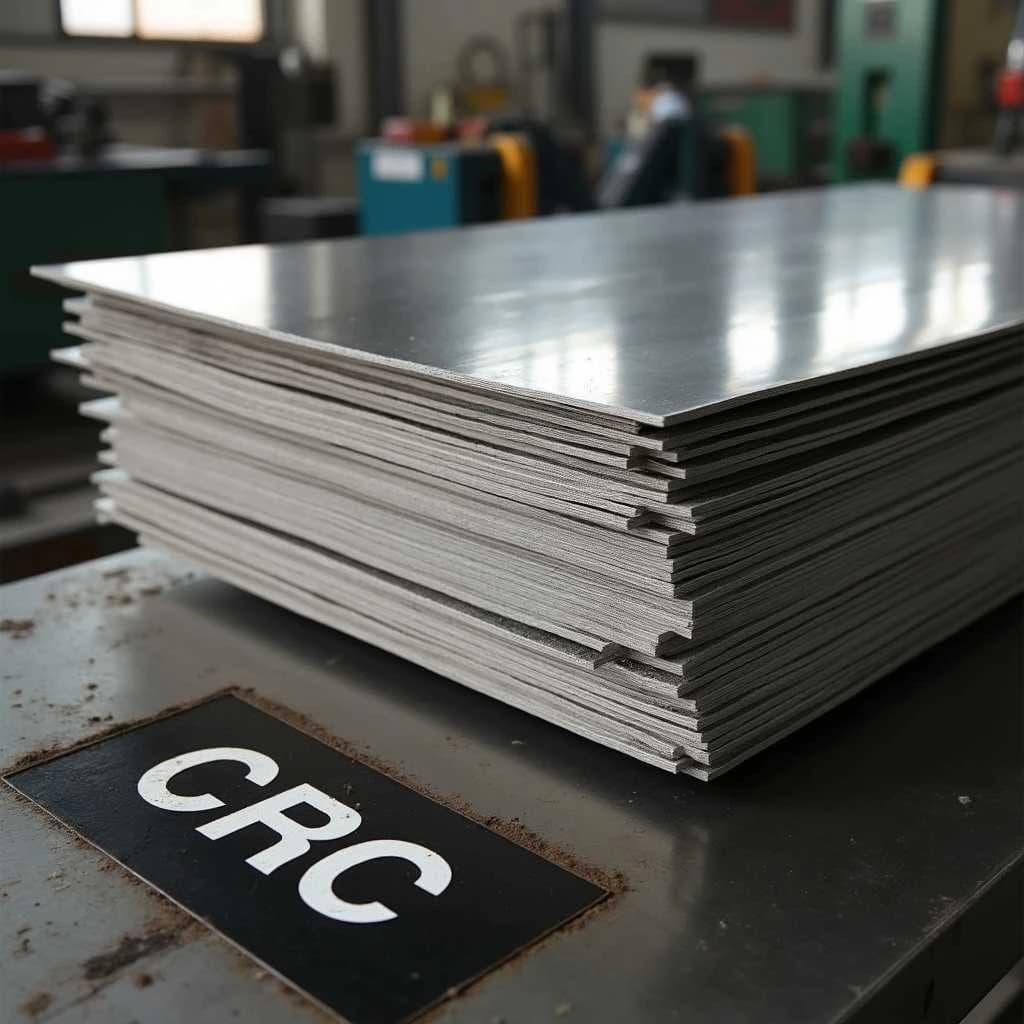
Why Grade Selection Is a Process Decision, Not a Material Decision
Hot Rolled steel is produced by rolling steel billets at temperatures above 926 degrees Celsius. The high-temperature process produces a characteristic blue-grey mill scale surface, a relaxed internal grain structure, and thickness tolerances of plus or minus 0.15mm. These properties make HR the correct choice for structural frames, base plates, machine brackets, and any weldment where the surface will be ground, primed, or is not visible in the finished assembly. Cold Rolled steel is produced by further processing HR coil at room temperature. This cold reduction refines grain structure, tightens thickness tolerance to plus or minus 0.05mm, and produces a smooth, scale-free surface. These properties make CR the correct choice for enclosures, electrical panels, automotive components, and any part going directly to powder coat or paint without extensive surface preparation. The surface condition difference between HR and CR is not cosmetic. It is a coating adhesion variable that determines whether a powder coat survives 18 months of field use or fails at 6.
Technical Insight
Mill scale on Hot Rolled steel is chemically inert and non-porous. Powder coat applied directly over mill scale with inadequate surface preparation will delaminate under thermal cycling or outdoor exposure within 6 to 18 months. Shot blasting to Sa 2.5 or mechanical grinding to St 3 surface cleanliness standards is mandatory before any coating application on HR steel. Cold Rolled steel accepts powder coat and wet paint with significantly less surface preparation because the base surface is already clean, smooth, and free of oxide scale.
Why It Matters
The grade decision at the RFQ stage is a financial decision disguised as a technical one. Wrong grade selection in either direction creates costs that never appear on the material invoice. They appear in rework logs, grinding hours, coating rejection reports, and client returns. At Aero Enterprises, grade confirmation is the first filter on every fabrication RFQ before any pricing discussion begins.
Hot Rolled Steel IS 2062: Where It Works and Where It Fails
HR IS 2062 is the correct specification for structural frames, load-bearing chassis, machine bases, base plates, and weldments where appearance is not a requirement. JSW and Tata certified coils are stocked directly at our Unit II Dhumal Nagar stockyard before dispatch to the floor. The coarser grain structure of HR is more forgiving of heat input variation during MIG and TIG welding, which means less distortion risk on heavy weldments compared to CR at the same thickness. The trade-off is surface condition. Mill scale must be fully removed before any coating or painting operation. Fabricators who apply powder coat over inadequately prepared HR surfaces are producing assemblies with a built-in failure timeline. HR is available from Aero Enterprises in thicknesses from 1.6mm to 12mm with JSW and TATA Mill Test Certificates on every consignment.
Cold Rolled Steel IS 513 Grades CQ, DQ, DDQ: Matching Sub-Grade to Application
CR IS 513 has three sub-grades that are not interchangeable. CQ (Commercial Quality) is for standard bending, forming, and general fabrication where draw depth is not a requirement. DQ (Drawing Quality) is for moderate deep draw stamping operations where CQ would crack or thin unevenly. DDQ (Deep Drawing Quality) is for severe draw ratios and complex stamping geometries where maintaining wall thickness and surface integrity through the full draw depth is a specification requirement. Sourced from mill-certified primary coils at Unit II Dhumal Nagar, ordering DQ or DDQ when CQ suffices is an unnecessary cost premium. Ordering CQ for a deep draw stamping job produces cracks, rejects, and tool damage. The sub-grade must match the forming severity, not just the application category.
Galvanized Steel IS 277: The Corrosion Variable That Cannot Be Skipped
GI is not an upgrade to HR or CR. It is a different material class for a different application category. The zinc coating is the corrosion barrier and its effectiveness is measured in GSM. For standard industrial roofing and interior cladding, 120 GSM minimum. For coastal zones, high-humidity industrial environments, or agricultural structures, 180 GSM or above. The critical fabrication constraint with GI is welding. Zinc vaporizes at 907 degrees Celsius, which is below steel welding temperature. Welding GI without proper extraction ventilation and respiratory protection creates direct zinc fume fever risk. The coating at the weld zone is destroyed during welding and must be repaired immediately with cold galvanizing compound or zinc-rich primer. Fabricators who skip post-weld zinc repair are shipping assemblies that will begin corroding at every weld point.
Thickness Selection and Machine Capability Constraints
Thickness is not only a weight and cost variable. It determines which fabrication processes are physically viable. Below 1.0mm, laser cutting or fine blanking is required because mechanical shearing creates excessive edge deformation and burr at this gauge range. Between 1.0mm and 3.0mm, shearing, laser, and plasma are all viable with edge quality being the differentiator. Additionally, CR below 1.2mm work-hardens aggressively at the weld zone, requiring stitch welding and controlled heat input to prevent distortion. Above 6.0mm, plasma or flame cutting becomes the cost-effective option and full-penetration weld joints require beveled edge preparation. CNC press brake bending capacity is governed by tonnage per meter of bed length. The 3100mm bed press brake at Unit I handles up to 6mm mild steel with standard tooling. Above 6mm, minimum inside bend radius increases sharply to avoid outer fiber cracking, and specialized tooling or hot bending may be required. Specifying thickness without verifying downstream machine constraints produces drawings that cannot be manufactured at the quoted cost.
Grade Mismatch Cost Analysis: What Wrong Selection Actually Costs
Ordering CR where HR suffices adds 12 to 18 percent to raw material cost with zero structural or functional benefit. On a 10-tonne order at current Mumbai mill pricing, that is a direct margin loss of approximately 1.2 to 1.8 lakh rupees. Ordering HR for a surface-critical coated panel adds 2 to 4 hours of grinding and blasting per batch. At a loaded labour and abrasive cost of 400 to 600 rupees per hour, that compounds to 1,600 to 2,400 rupees of additional prep cost per batch, recurring on every repeat order. Using GI without post-weld coating repair creates warranty liability that manifests in field. None of these costs are visible at point of purchase. They surface in rework logs, coating rejection rates, and client escalations. The grade decision is a margin protection decision.
Market Reality
The most expensive fabrication mistake is not ordering the wrong quantity. It is ordering the wrong grade. Most fabricators do not trace rework costs back to the original grade selection error. They blame the welder for the distortion, the powder coater for the delamination, and the press operator for the cracked stamping. The root cause in each case is a grade decision made on price or availability rather than process requirements. This pattern repeats across hundreds of fabrication workshops in the Mumbai corridor because the error is invisible at the point of purchase and only visible weeks or months into production.
At Aero Enterprises Unit I production floor in Vasai Phata, the internal rule that has held across 36 years of fabrication is this: grade is confirmed before any job is quoted, not after it is accepted. When a fabrication RFQ arrives, the first four questions are always about application context, surface finish requirement, coating system, and structural loading. These four answers determine grade, surface condition, and thickness range before any price is discussed. A quote generated without this context is a guess. A guess that wins an order creates a rework problem. Our Unit II Dhumal Nagar hub stocks primary JSW and TATA certified coils in HR, CR, and GI simultaneously so grade adjustments within an active order are resolved at the stock level without a second procurement cycle or a lost production day.
Get a DFM Review from Aero EnterprisesData and References
- HR IS 2062 thickness tolerance is plus or minus 0.15mm versus CR IS 513 tolerance of plus or minus 0.05mm
- Zinc vaporizes at 907 degrees Celsius, below steel welding temperature, making ventilation mandatory when welding GI
- Ordering CR where HR suffices adds 12 to 18 percent to raw material cost with no structural benefit
- Mill scale on HR steel requires Sa 2.5 shot blast or St 3 mechanical grind before powder coat application
- CR below 1.2mm work-hardens aggressively at the weld zone, requiring stitch welding and controlled heat input to prevent distortion
- GI for coastal or high-humidity environments requires a minimum of 180 GSM zinc coating
- Wrong grade selection costs manifest in rework logs and coating rejection rates, not on the material invoice
Steel Supply at Unit II Dhumal Nagar
Frequently Asked Questions
What is the difference between HR and CR sheet metal?
HR (Hot Rolled) steel is produced at high temperatures and has a rough mill scale surface with wider thickness tolerance. It is used for structural and weldment applications. CR (Cold Rolled) steel is processed at room temperature and has a smooth, scale-free surface with tighter tolerance. It is used for precision-formed and surface-critical coated components.
Can I use HR steel for powder-coated panels?
HR steel can be powder coated, but mill scale must be completely removed first through shot blasting to Sa 2.5 or mechanical grinding to St 3 before coating. Powder coat applied over inadequately prepared HR surface will delaminate within 6 to 18 months. For surface-critical panels, CR is the correct choice because it requires significantly less prep.
What does DDQ grade mean in CR steel?
DDQ stands for Deep Drawing Quality, a sub-grade of CR IS 513. It is engineered for severe draw ratios and complex stamping geometries where standard CQ or DQ grades would crack or thin unevenly through the draw depth. It is the correct specification for deep-drawn automotive panels and complex enclosure stampings.
What GSM zinc coating is required for outdoor GI applications?
For standard indoor or sheltered industrial applications, 120 GSM minimum. For outdoor, coastal, or high-humidity industrial environments, 180 GSM or above is required to provide adequate corrosion protection over the service life of the assembly.
Which steel grade should I use for HVAC ducting in Mumbai?
For interior HVAC ducting, CR IS 513 CQ grade is standard. For exterior or rooftop ducting exposed to Mumbai's coastal humidity and monsoon conditions, GI IS 277 at 180 GSM minimum is the correct specification. Using CR without coating in outdoor ducting applications will produce visible corrosion within one monsoon cycle.
Does Aero Enterprises stock all three grades in primary quality?
Yes. Aero Enterprises Unit II at Dhumal Nagar stocks JSW and TATA certified primary coils in HR, CR, and GI simultaneously. Mill Test Certificates are available on every consignment. Grade changes within an active order are handled at the stock level without requiring a second procurement cycle.
Recommended Technical Reading
What Is Sheet Metal Manufacturing and How Does It Work?
Sheet metal manufacturing is the industrial process of converting flat metal sheets into finished components through cutting, punching, bending, and forming operations. It forms the backbone of electrical enclosures, automotive brackets, HVAC systems, and heavy machinery structures.
Sheet Metal Laser Cutting: The Complete Guide for Indian Fabricators
Laser cutting is the most precise sheet metal cutting process available in industrial fabrication today. But precision is only as useful as the decisions made before the laser fires: material grade, sheet flatness, kerf compensation, assist gas selection, and nesting efficiency. Fabricators who treat laser cutting as a commodity service and ignore these variables are paying for precision they are not actually receiving.
Flood Light Mounting Bracket Manufacturing: Sheet Metal Fabrication Guide
A flood light mounting bracket is one of the most mechanically stressed components in any outdoor lighting installation. It carries the full dead weight of the fixture, absorbs wind load continuously, and sits exposed to UV, rain, and coastal salt air for a service life measured in decades. Most procurement decisions for flood light brackets are made on price per piece. The correct decision is made on material grade, coating system, bend geometry, and fabrication process. A bracket that fails at 18 months in an outdoor installation is not a cheap bracket. It is an expensive one.
Production Infrastructure
20 Power Presses · 3000W Laser · 7-Tank Powder Coat · CNC Bending