CNC Press Brake & Sheet Metal Bending Job Work Vasai - Mumbai - Palghar
CNC + Manual + Power Press Bending - 0.5mm to 8mm MS - CR / HR / GI / SS 304 / SS 316 - ±0.5° Angular Tolerance - ISO 9001:2015
Aero Enterprises Unit I, Vasai Phata provides CNC press brake and sheet metal bending job work in Vasai, Mumbai, and Palghar. We operate a multi-axis CNC press brake, manual press brakes, and power press form bending on one production floor. ISO 9001:2015 certified CNC bending services with K-factor springback compensation, first-off angular inspection, and integrated powder coat finishing for LED lighting, automotive, solar tracker, and furniture OEM clients.
Expertise and Experience
Aero Enterprises Unit I Vasai Phata operates a complete sheet metal bending division covering three bending process types: CNC multi-axis press brake for precision profile and enclosure bending, manual press brakes with back gauge for structural and bracket bending, and power press form bending for high-volume profiles. We allocate the correct bending process to each job based on geometry, volume, tolerance, and material grade. Precision enclosure work goes to the CNC press brake. High-volume bracket bending goes to the power press floor. Structural profiles go to the manual press brakes. Every job begins with a programmed bend sequence before the first piece is loaded.
Why Our Process Wins
The most common bending failure is wrong bend sequence programming and uncompensated springback. At Aero Enterprises Unit I, every CNC press brake job has a bend sequence programmed into the controller, with springback compensation calculated per material grade and thickness using K-factor bend allowance data. First-off angle verification is mandatory before batch production is approved.
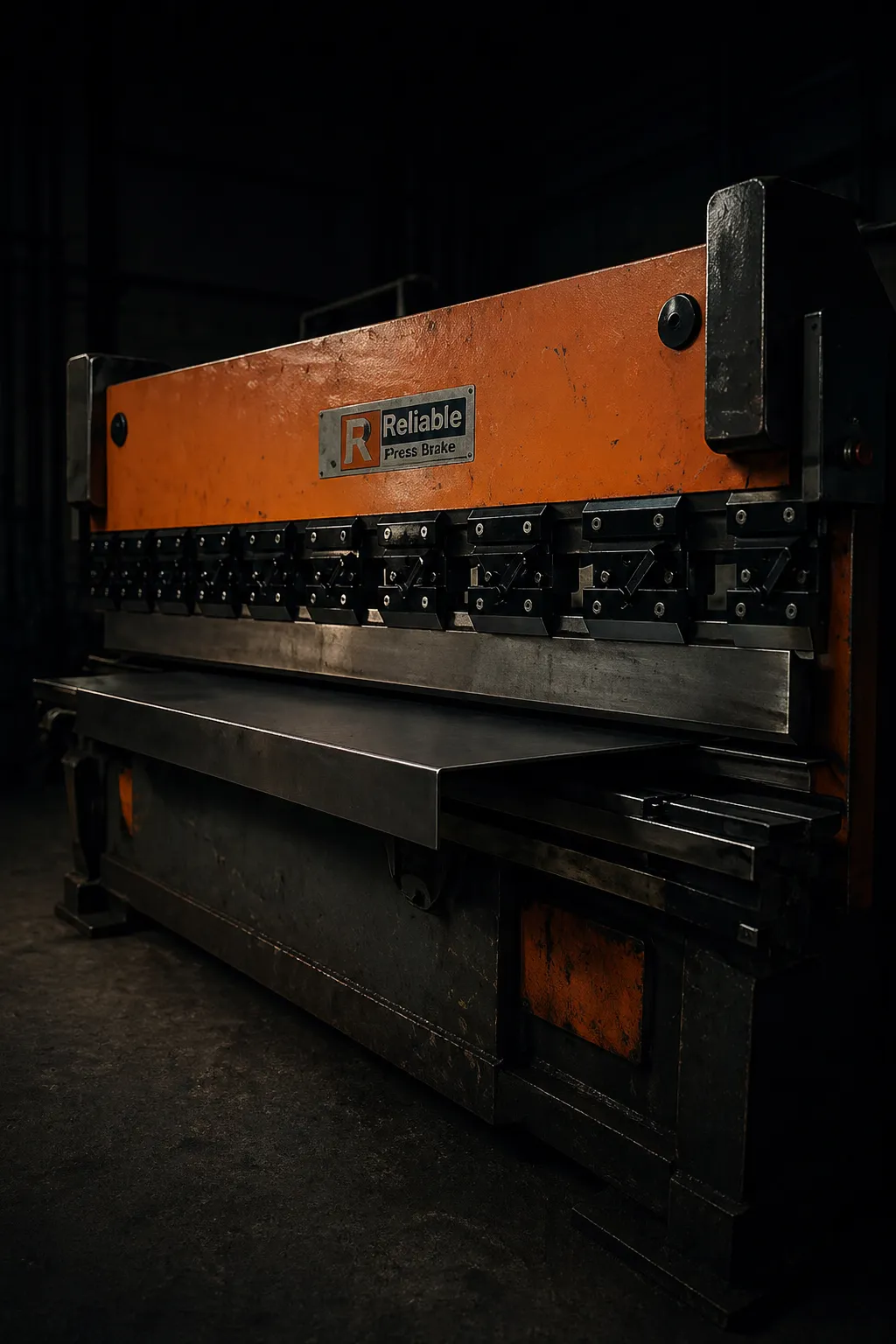
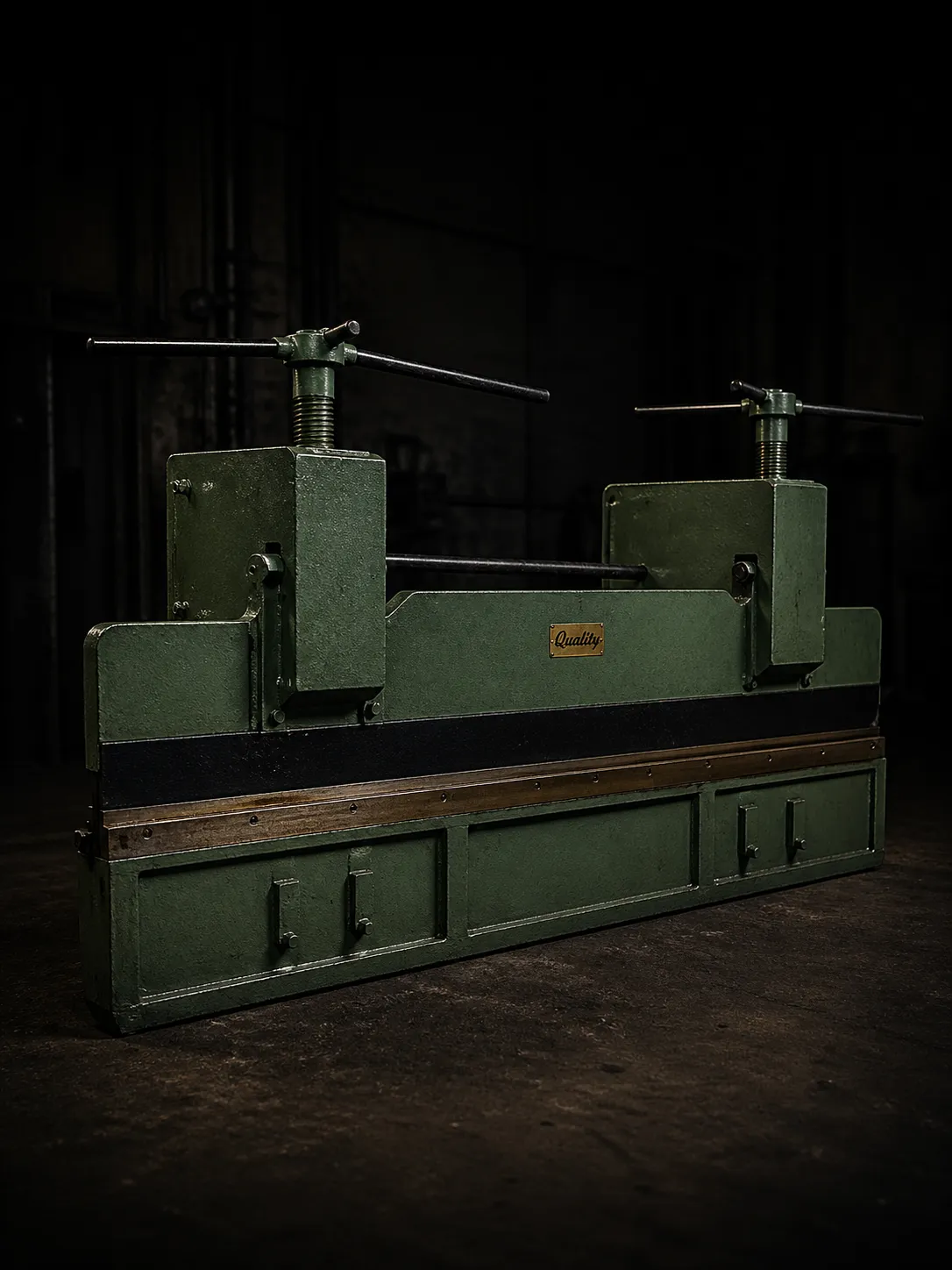
Machinery · Unit I Vasai Phata
CNC Press Brake 100T/3100mm (Multi-Axis Back Gauge), 2x Manual Press Brakes (6.5ft), 20x Power Presses. Integrated with Fiber Laser, Welding, and 7-Tank Powder Coat Line.
Core Capabilities
Verification Protocol
Bend sequence programming review before first blank loading.
First-off angle verification using calibrated digital protractor.
K-factor bend allowance calculation per material grade.
Springback compensation validation on first-off sample.
Tooling wear monitoring for V-die radius consistency.
Final dimensional audit on finished batch before dispatch.
Stamping Operations
Six stamping and forming operations run simultaneously across the 20-press floor. Each has a correct application — specifying the wrong operation produces defects that cannot be corrected downstream.
Air Bending
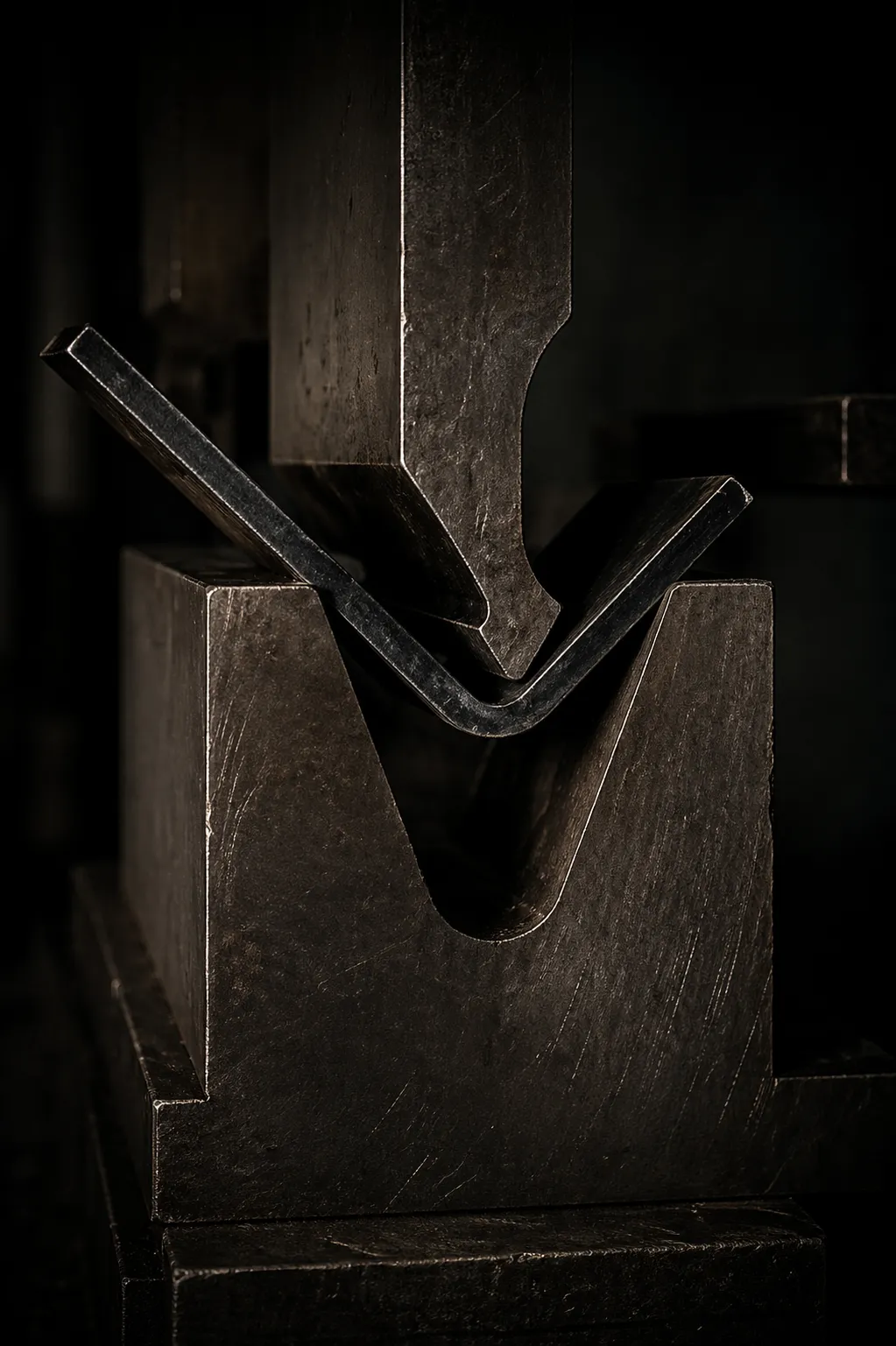
Punch presses sheet into V-die without bottoming out. Flexible, handles multiple angles with one die set.
Applications
Brackets, enclosure flanges, mounting plates.
Bottom Bending
Punch forces sheet fully to die floor, coining the zone to eliminate springback. Correct for tight-tolerance profiles.
Applications
Precision enclosure panels, electrical cabinet frames.
Hemming
Folding edge onto itself for safe, closed flat edge. Improves rigidity without material increase.
Applications
LED panel edges, enclosure door edges, furniture panels.
Offset Bending
Z-shaped step profile in one stroke. Correct for overlap joints and raised platforms.
Applications
Step brackets, overlap flanges, Z-profiles.
Box & Pan Bending
Sequential bending of four flanges from one blank. Used for enclosure bodies.
Applications
Electrical enclosures, LED driver boxes, structural frames.
Multi-Bend Profiles
Complex 4+ bend sequences (channels, hat sections). CNC back gauge maintains cumulative accuracy.
Applications
Structural channels, solar tracker rails, furniture frames.
Progressive vs Compound
vs Deep Draw Die
Die type determines per-part cost, tooling investment, and achievable tolerance. Wrong die type for the volume produces either over-investment or inadequate batch consistency.
CNC Press Brake
Best For
Enclosures, multi-bend profiles, SS scratch-free
Manual Press Brake
Best For
Structural brackets, non-standard geometry
Power Press Bending
Best For
L-brackets, U-channels, Z-sections
Manufacturing ID · Unit I Vasai Phata
Unit I Capability
CNC Press Brake 100T/3100mm (Multi-Axis Back Gauge), 2x Manual Press Brakes (6.5ft), 20x Power Presses. Integrated with Fiber Laser, Welding, and 7-Tank Powder Coat Line.
Industries Served
Industrial Applications
LED Lighting
Enclosure shells, heat sink housings, mounting brackets.
Solar Tracker OEMs
Structural frame profiles, pivot arms, mounting plates.
Automotive OEMs
Bracket weldments, reinforcement plates, seat frame components.
Furniture
Wall unit panels, frame sections, modular support components.
Stationery
Hardware assembly, mechanism housing profiles.
Industrial Fabrication
Custom enclosures, panel frames, HVAC sections.
CNC Multi-Axis Bending | Aero Enterprises Vasai — Technical FAQ
Common technical and commercial questions about cnc multi-axis bending | aero enterprises vasai at Aero Enterprises Unit I, Vasai Phata.
What is CNC press brake bending in sheet metal fabrication?
CNC press brake bending is a sheet metal forming operation where a hydraulic press brake forces a punch into sheet material positioned over a V-die to produce a precise angular bend. The bend angle, back gauge position, and punch travel depth are all controlled by a CNC controller — eliminating manual setting errors and producing consistent angular accuracy across the full batch. At Aero Enterprises Unit I, Vasai Phata, CNC press brake bending handles material from 0.5mm to 8mm MS and 5mm SS in CR IS 513, HR IS 2062, GI IS 277, SS 304, SS 316, aluminium, brass, and copper.
How does a CNC bending machine work?
A CNC bending machine — or CNC press brake — works by clamping sheet metal between a punch (top tool) and a V-die (bottom tool) and applying controlled press force to form a precise bend angle. The CNC controller manages three variables: punch travel depth (which controls the bend angle), back gauge position (which controls flange length), and press speed. The back gauge positions automatically between bends for multi-bend sequences, meaning the operator loads the blank and the machine produces every bend in the programmed sequence without manual measurement. At Aero Enterprises Unit I, the CNC press brake is a 100T / 3100mm machine with multi-axis back gauge.
What is multi-axis back gauge bending and why does it matter?
A multi-axis CNC back gauge positions the sheet metal precisely before each press stroke — controlling the X axis (front-to-back depth) and Z axes (left-right position) independently. This allows the machine to reposition automatically between bends on a multi-bend profile without manual measurement or operator repositioning between strokes. The result is consistent flange lengths and cumulative angular accuracy across complex bend sequences that single-axis or manual back gauge machines cannot reliably maintain.
What is the difference between air bending and bottom bending?
Air bending controls the bend angle by punch penetration depth — the sheet does not contact the full die surface, which allows one die set to produce multiple angles. It is the standard method for most sheet metal bending work. Bottom bending forces the sheet fully to the die floor, coining the bend zone and eliminating springback variation — correct for tight-tolerance profiles where air bending angle variation across the batch is not acceptable. At Aero Enterprises Unit I, the correct method is selected based on material grade, thickness, angular tolerance, and batch volume.
What is springback in sheet metal bending and how is it controlled?
Springback is the elastic recovery of sheet metal after bending force is released — the bend angle opens slightly from the intended angle. Springback magnitude varies by material grade, thickness, temper, and bend radius. At Aero Enterprises Unit I, springback compensation values for each material and thickness combination are programmed into the CNC press brake controller using K-factor bend allowance data. First-off angular verification confirms the compensation is correct before batch production begins.
What materials can be bent at Aero Enterprises Unit I?
CNC press brake bending at Aero Enterprises Unit I handles CR IS 513 (CQ, DQ, DDQ), HR IS 2062, GI IS 277, SS 304, SS 316, aluminium, brass, and copper. Material thickness range is 0.5mm to 8mm for mild steel and up to 5mm for stainless steel on the 100T CNC press brake. All material enters production from JSW and TATA primary certified coils verified against Mill Test Certificates at Unit II Dhumal Nagar.
What angular tolerance does CNC bending achieve at Aero Enterprises?
CNC press brake bending at Aero Enterprises Unit I achieves ±0.5° angular tolerance across the full 3100mm bed length with ±0.01mm back gauge positioning repeatability. First-off angular inspection using a calibrated digital protractor is performed on all bend angles before batch production is approved on every job.
What is the minimum bend radius for sheet metal bending?
Minimum internal bend radius is a function of material grade and thickness. For CR IS 513 CQ grade, minimum internal radius is 1.0× material thickness. For HR IS 2062, minimum is 1.5× material thickness. For SS 304 and SS 316, minimum is 1.0× material thickness due to work hardening characteristics. Bending below the minimum radius for the grade causes fracture or cracking at the bend zone. At Aero Enterprises Unit I, minimum bend radius is confirmed against the material certificate before tooling is selected.
Can Aero Enterprises bend pre-punched or pre-stamped components?
Yes. The standard production sequence at Aero Enterprises Unit I is stamping or laser cutting first — producing all holes, slots, and blank profiles — followed by CNC press brake bending. Pre-punched components are bent with hole pattern orientation referenced to back gauge position to maintain the relationship between hole centres and bent flanges. This is the correct sequence for enclosure bodies, bracket profiles, and structural frames where hole-to-flange dimensional accuracy is a specification requirement.
What is the minimum order quantity for CNC bending job work at Aero Enterprises?
Aero Enterprises Unit I processes CNC bending job work from 50 pieces upward for repeat profiles where a bend programme already exists. New profiles require first-off setup and programme creation — performed on the first order and retained for all repeat production. For prototype and design validation, single pieces and small batches are accepted with a setup charge. Clients supplying DXF files with bend sequence notation reduce setup time and cost significantly.
Have a Technical Question Not Listed Here?
Contact our engineering desk directly. We respond with technical specifics, not sales language.
Contact Engineering DeskTechnical Guides
for CNC Multi-Axis Bending | Aero Enterprises Vasai
2026-03-03
From Flat Sheet Metal to Precision Component: How Aero Enterprises Does It
A flat sheet of mild steel sitting in the stockyard at Aero Enterprises Unit II Dhumal Nagar has no value to a client. The value is created at Unit I Vasai Phata, where that sheet goes through a defined sequence of power press stamping, CNC bending, and punching operations to become a finished precision component that fits a specific assembly, carries a specific load, and meets a specific dimensional tolerance. That transformation is not a series of independent steps. It is a production system. Understanding how that system works, what each process contributes, and where the failure points are is the difference between a client who gets consistent precision parts and one who gets consistent rejections.
2026-03-01
Flood Light Mounting Bracket Manufacturing: Sheet Metal Fabrication Guide
A flood light mounting bracket is one of the most mechanically stressed components in any outdoor lighting installation. It carries the full dead weight of the fixture, absorbs wind load continuously, and sits exposed to UV, rain, and coastal salt air for a service life measured in decades. Most procurement decisions for flood light brackets are made on price per piece. The correct decision is made on material grade, coating system, bend geometry, and fabrication process. A bracket that fails at 18 months in an outdoor installation is not a cheap bracket. It is an expensive one.
2026-03-15
L Patti Manufacturing: How Steel Corner Brackets for Furniture Are Made
An L patti is one of the most structurally critical components in a wooden furniture assembly and one of the most consistently under-specified. Furniture manufacturers across India source corner brackets on unit price alone, without specifying sheet thickness, hole pattern accuracy, bend radius, or coating system. The result is brackets that deform under joint load, loosen at 12 months, and generate warranty returns that cost multiples of the original hardware saving. At Aero Enterprises Unit I Vasai Phata, L patti corner brackets are manufactured as precision stamped and powder coated structural hardware, not as commodity press shop output.
2026-03-05
Wall Unit Folder Bracket Manufacturing: Sheet Metal Stamping Guide
A wall unit folder bracket is one of those components that nobody thinks about until it fails. It carries the static weight of loaded document folders every day, takes repeated dynamic loading every time a folder is removed or replaced, and sits on a wall unit that may be moved, reinstalled, and reconfigured multiple times over its service life. Most buying decisions for folder brackets are made on unit price alone. The correct decision is made on sheet thickness, die geometry, mounting hole pattern, and powder coat system. A bracket that deforms at 6 months or whose coating chalks off in a year is not a cost saving. It is a replacement cost plus downtime.