Wall Unit Folder Bracket Manufacturing: Sheet Metal Stamping Guide
A wall unit folder bracket is one of those components that nobody thinks about until it fails. It carries the static weight of loaded document folders every day, takes repeated dynamic loading every time a folder is removed or replaced, and sits on a wall unit that may be moved, reinstalled, and reconfigured multiple times over its service life. Most buying decisions for folder brackets are made on unit price alone. The correct decision is made on sheet thickness, die geometry, mounting hole pattern, and powder coat system. A bracket that deforms at 6 months or whose coating chalks off in a year is not a cost saving. It is a replacement cost plus downtime.
Aero Enterprises Desk
High-volume sheet metal bracket stamping, progressive die operations, and powder coat finishing for hardware and storage system applications
“Content compiled from active wall bracket and hardware component stamping operations at Unit I Vasai Phata, processing CR IS 513 sheet stock through hydraulic press stamping and automated powder coat conveyor finishing for office furniture, storage system, and modular hardware clients across Mumbai and the wider Maharashtra industrial belt.”
Last Reviewed: 2026-05-24
Direct Answer
Wall unit folder brackets are manufactured from Cold Rolled sheet metal using hydraulic press stamping to produce the bracket profile, mounting holes, and hanging lip geometry in a single progressive die sequence, followed by deburring and powder coat finishing. Aero Enterprises manufactures wall unit folder brackets at Unit I Vasai Phata using in-house hydraulic stamping presses and an automated powder coat conveyor line.
Quick Summary
- Wall unit folder brackets are high-repetition load components requiring correct sheet thickness and die geometry, not just cheap unit pricing
- CR IS 513 CQ grade is the correct base material for folder brackets going to powder coat finishing
- Progressive die stamping is the correct process for high-volume folder bracket production above 500 pieces per order
- Mounting hole pattern accuracy is a critical dimension, not a secondary specification
- Powder coat without zinc phosphate pretreatment fails on brackets in humid office and warehouse environments within 12 to 18 months
- High-volume stamping and automated powder coating ensure durable office hardware brackets.
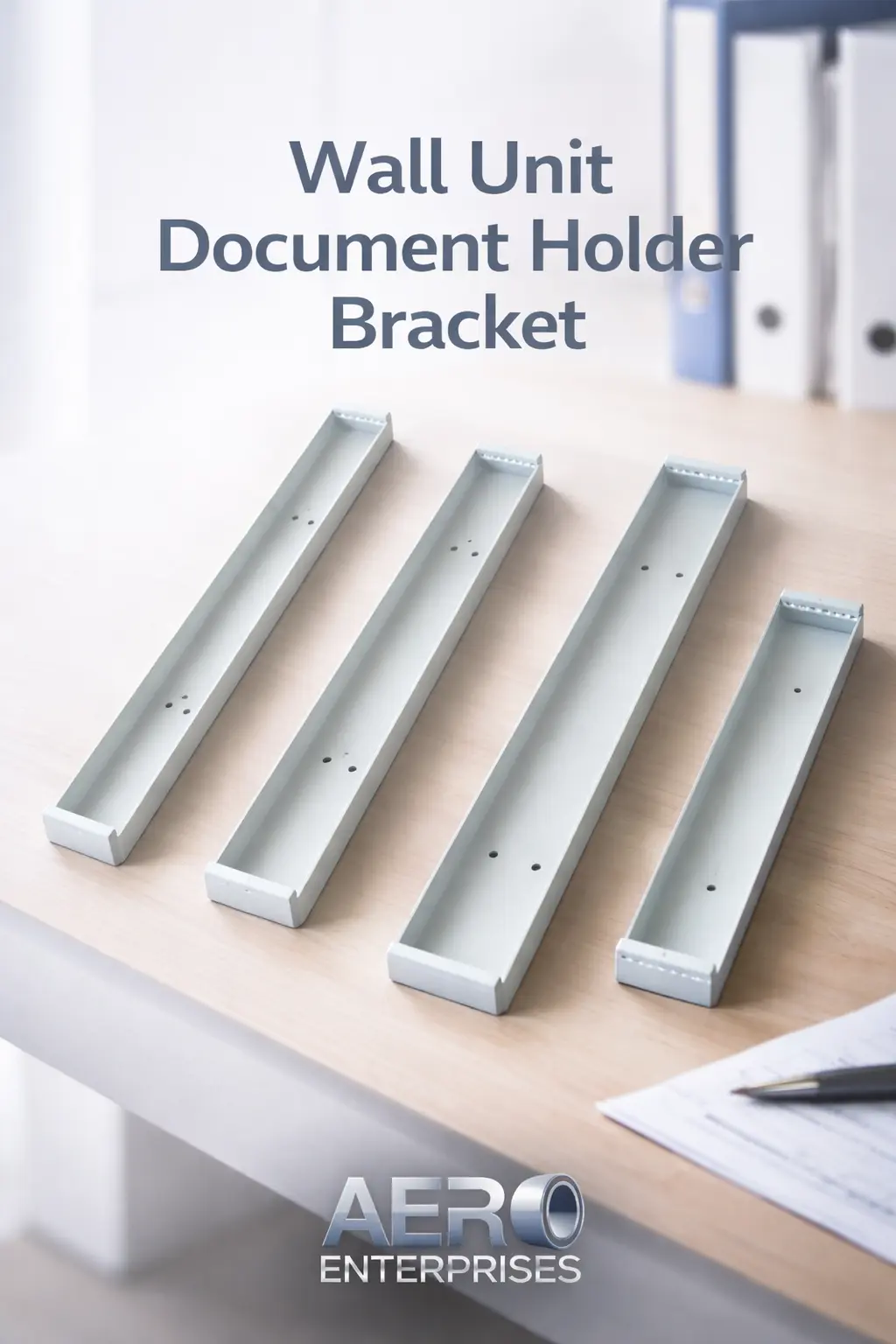
Why a Folder Bracket Is a Precision Component, Not a Sheet Metal Commodity
A wall unit folder bracket performs three simultaneous mechanical functions that are easy to underestimate because the component is small and low-cost at first glance. First, it carries repeated static load. A standard A4 document folder weighs between 0.3 and 1.2 kilograms fully loaded. A wall unit rail holding 20 to 30 folders applies a continuous distributed load of 6 to 36 kilograms across all brackets on that rail. Second, it absorbs dynamic impact loading every time a user removes or replaces a folder, which in an active office or warehouse environment happens dozens of times per day. This cycle count over a 5-year service life represents tens of thousands of load reversals on every bracket. Third, it must maintain dimensional registration with the wall unit rail system it attaches to. Mounting hole pattern deviation of even 0.3mm can make a bracket incompatible with its rail or cause it to sit at an angle that progressively loosens the hanging lip contact over time. None of these requirements are visible on a unit price quote. They are determined entirely by stamping die accuracy, material selection, and sheet thickness specification at the design and tooling stage.
Technical Insight
The most common failure mode in stamped folder brackets is plastic deformation of the hanging lip under repeated dynamic loading. The hanging lip is the formed feature that engages the folder suspension rod or rail. If the lip geometry is produced with insufficient bend radius, the material at the outer fiber of the bend is over-stressed during forming, creating a micro-cracked zone that propagates under service loading until the lip permanently deflects downward and loses grip on the folder. At Aero Enterprises Unit I, hanging lip geometry on folder brackets is stamped using hardened die inserts with a minimum bend radius of 0.8 times material thickness for CR IS 513 CQ at 1.5mm. This geometry produces a lip with full material integrity at the bend outer fiber and a service life that exceeds the wall unit system it is installed in. Secondary failure occurs at mounting holes when hole diameter is stamped undersized relative to the fastener and the bracket is force-fitted to the wall unit rail. Force-fitting expands the hole edge plastically, loosening the fastener engagement over time. Correct hole diameter is specified at fastener diameter plus 0.1 to 0.15mm clearance, not nominal fastener diameter.
Why It Matters
Procurement teams sourcing wall unit folder brackets on unit price alone are absorbing replacement costs, field installation time, and end-user complaints that accumulate over the product lifecycle and far exceed the per-unit price difference between a correctly specified bracket and an underspecified one. At Aero Enterprises, folder bracket orders are reviewed for sheet thickness adequacy, lip geometry, hole pattern accuracy, and coating system specification before any production begins. This review takes 20 minutes. It eliminates the most common failure modes before a single sheet is loaded into the press.
Material Selection for Wall Unit Folder Brackets: Sheet Grade and Thickness
Cold Rolled IS 513 CQ grade is the correct base material specification for wall unit folder brackets in standard office, commercial, and light industrial environments. The smooth, scale-free CR surface accepts powder coat with high adhesion and produces a consistent cosmetic finish across the full bracket face, including inside bend radii and stamped hole edges. Sheet thickness for folder brackets ranges from 1.2mm for lightweight document folder applications with short rail spans to 2.0mm for heavy-duty warehouse folder storage systems carrying ring binders and lever arch files. Specifying 1.0mm CR to reduce material cost on a bracket carrying lever arch files is a mechanical failure waiting to happen. The section modulus of a 1.0mm bracket lip under the combined weight and dynamic impact of a fully loaded lever arch file is below the yield strength threshold, producing permanent deformation within weeks of installation. The correct thickness specification is derived from the maximum expected load per bracket, the lip engagement length, and the dynamic impact factor for the use frequency of the installation. This calculation takes 10 minutes at design stage. Skipping it and defaulting to the thinnest available sheet costs multiples of the material saving in replacements.
Progressive Die Stamping for Folder Bracket Production: Process and Volume Thresholds
Progressive die stamping is the correct manufacturing process for wall unit folder bracket production at volumes above 300 to 500 pieces per order. A progressive die for a folder bracket performs the complete sequence of blanking the outer profile, piercing mounting holes and any ventilation or weight-reduction apertures, forming the hanging lip, and bending the mounting flange in a single continuous press stroke sequence fed from a CR coil strip. This produces a finished net-shape bracket requiring only deburring and coating before dispatch. The consistency advantages of progressive die stamping over individual piece laser cut and bend operations are significant for folder brackets specifically because the hanging lip geometry and the mounting hole pattern must be identical across every piece in a batch for the brackets to be interchangeable on a wall unit rail system. Dimensional variation between pieces produced by manual bending operations creates installation problems that surface in the field rather than at goods inward inspection. At Aero Enterprises Unit I, folder bracket progressive dies are maintained in-house, allowing geometry modifications between production runs without external tooling lead time or cost.
Mounting Hole Pattern Accuracy: Why It Is a Critical Dimension on Every Drawing
Mounting hole pattern is the interface dimension between the folder bracket and the wall unit rail system it attaches to. If the hole pattern on the bracket does not match the fixing pattern on the rail within the tolerance that the fastener clearance permits, the bracket either does not fit or fits with pre-loaded stress at the fixing points that reduces fatigue life and causes progressive loosening in service. For wall unit systems with a standard hole grid, bracket hole pattern tolerance must be held to plus or minus 0.2mm on centre-to-centre dimensions to ensure interchangeability across all bracket positions on the rail. This tolerance is achievable with a correctly maintained stamping die but is not achievable with manually operated bench drilling operations or with worn tooling. Every progressive die at Aero Enterprises Unit I is dimensionally verified on first-off samples using calibrated measurement against the drawing before full production is approved. Hole pattern is always included in the first-off measurement protocol, not treated as a secondary dimension to be verified at goods inward by the client.
Powder Coat Specification for Folder Brackets: What a Correct Coating System Includes
Powder coat on a folder bracket that will spend its service life in an office, warehouse, or light industrial environment needs to perform two functions. First, corrosion protection of the base CR steel against the condensation, cleaning chemicals, and humidity cycling present in any occupied building environment. Second, cosmetic consistency, because folder brackets are visible components on a wall unit system and colour mismatch or coating defects are immediately apparent to end users. A single-coat powder finish applied directly to bare CR steel without pretreatment satisfies neither requirement reliably. The correct powder coat system for folder brackets is two-stage. Stage one is an iron phosphate or zinc phosphate conversion coat applied after alkaline degreasing and water rinse. This layer converts the steel surface to a crystalline phosphate structure that provides mechanical and chemical adhesion for the subsequent powder coat. Stage two is a polyester powder coat top coat applied electrostatically and oven-cured at 180 to 200 degrees Celsius to a dry film thickness of 60 to 80 microns on flat faces. Inside bend radii and punched hole edges must be verified at minimum 50 microns to confirm adequate edge coverage. The automated conveyor powder coat line at Aero Enterprises Unit I processes folder brackets through this complete two-stage system. Coating thickness is measured on every production batch before dispatch.
Deburring After Stamping: The Step That Determines Whether a Bracket Is Safe to Handle
Stamping produces burrs at all sheared edges, including the outer blank perimeter, mounting holes, and any internal apertures. Burr height on CR IS 513 at 1.5mm thickness from a well-maintained die is typically 0.05 to 0.10mm, which is sharp enough to cut unprotected hands during installation and handling. Burr height from a worn or poorly maintained die can exceed 0.3mm, which is a significant laceration risk. Deburring is a mandatory post-stamp operation before any powder coat application, both for safe handling and because powder coat applied over sharp burrs produces thin coating at the burr tip that fails first under corrosion exposure. At Aero Enterprises Unit I, all stamped brackets are passed through a vibratory deburring tumbler after stamping and before entering the powder coat line. This produces a consistent edge condition across the full batch, eliminates sharp edges, and provides a surface receptive to even powder coat build-up including at sheared hole edges and blank perimeter corners.
Quality Verification for Folder Bracket Production: What Is Checked and When
Wall unit folder bracket quality verification covers four stages at Aero Enterprises Unit I. First-off dimensional check confirms that the progressive die is producing brackets within tolerance on all critical dimensions including mounting hole pattern, lip geometry, overall height and width, and flange angle before full production run begins. This check is performed on the first 5 pieces of every production run and after any die maintenance or tool change. In-process sampling checks dimensional conformity and burr condition at defined intervals through the production run. Post-deburring inspection verifies that sheared edge condition is acceptable before the batch enters the powder coat line. Any batch with unacceptable burr condition is returned to deburring. Post-coating inspection verifies dry film thickness on flat faces and inside bend radii, colour conformity to the specified RAL standard, and adhesion by cross-cut test on a sample from each batch. Batches failing coating thickness on inside radii are stripped and recoated rather than dispatched with inadequate edge protection.
Market Reality
The wall unit folder bracket market in India is almost entirely price-driven at the procurement level. Furniture system integrators, modular office fitout contractors, and warehouse storage system suppliers specify brackets by compatibility with their rail system and unit cost, without specifying sheet thickness, die tolerances, hole pattern accuracy, or coating system. The result is a supply chain full of 1.0mm CR brackets with single-coat powder finish, produced with worn tooling that cannot hold hole pattern tolerance, and dispatched without deburring verification. These brackets reach site, get installed by a fitout team that has no time to inspect components, and begin failing within the first year of use. Lips deform, mounting holes oval out, coating chalks in humid environments, and the end client raises a warranty claim against the fitout contractor who raises it against the furniture supplier who raises it against the bracket manufacturer. The entire cost chain traces back to a procurement decision made on unit price without any specification depth.
At Aero Enterprises Unit I Vasai Phata, folder bracket orders are reviewed against four parameters before any production commitment is made. Sheet thickness adequacy for the stated load application. Mounting hole pattern tolerance against the client's rail system drawing. Lip geometry against the folder suspension method. And coating system specification against the installation environment. Clients who arrive with only a unit price target and a rough sketch are walked through these four parameters before any price is discussed, because a bracket priced without this information is a guess that becomes a warranty problem. Our in-house progressive die capability means geometry adjustments between production runs are handled without external tooling lead time. For clients supplying modular office or warehouse storage systems at volume, this means specification changes can be incorporated within the same order cycle rather than waiting for a new tooling program.
Get a DFM Review from Aero EnterprisesData and References
- A fully loaded A4 document folder weighs between 0.3 and 1.2 kilograms
- A fully loaded lever arch file weighs between 1.5 and 3.0 kilograms
- Vibratory tumbling at Aero Enterprises floor achieves an edge radius chamfer of 0.2mm to 0.3mm to ensure zero burr and maximum coating adhesion.
- Mounting hole pattern tolerance for interchangeable folder bracket systems must be held to plus or minus 0.2mm on centre-to-centre dimensions
- Hanging lip bend radius below 0.8 times material thickness creates micro-cracking at the outer fiber that propagates under repeated dynamic loading
- Burr height from a well-maintained stamping die on CR IS 513 at 1.5mm is 0.05 to 0.10mm; worn tooling produces burrs above 0.3mm
- Correct powder coat system for folder brackets requires phosphate conversion coat pretreatment plus 60 to 80 microns polyester top coat dry film thickness
- Progressive die stamping becomes more cost-effective than individual piece processing above 300 to 500 pieces per order
- Dry film thickness on inside bend radii must be verified at minimum 50 microns to ensure adequate edge corrosion protection
Steel Supply at Unit II Dhumal Nagar
Frequently Asked Questions
What sheet metal thickness is correct for wall unit folder brackets?
Thickness depends on the load application. For lightweight A4 document folders in standard office environments, 1.2mm CR IS 513 CQ is the minimum correct specification. For heavy-duty lever arch file or ring binder storage in warehouse environments, 1.5mm to 2.0mm is required. Specifying 1.0mm to reduce unit cost on a heavy-duty application produces permanent lip deformation within weeks of installation.
Why does mounting hole pattern accuracy matter on a folder bracket?
The mounting hole pattern is the interface dimension between the bracket and the wall unit rail system. Hole pattern deviation beyond the fastener clearance tolerance means brackets either do not fit or fit with pre-loaded stress at fixing points. Pre-loaded stress at fixing points reduces fatigue life and causes progressive loosening in service, producing brackets that rock on the rail and eventually disengage.
Does Aero Enterprises manufacture custom wall unit folder brackets?
Yes. Aero Enterprises manufactures custom wall unit folder brackets at Unit I Vasai Phata using in-house hydraulic stamping presses and progressive die tooling maintained on-site. Custom hole patterns, lip geometries, and overall dimensions are accommodated through in-house die modification. All brackets are finished on the automated powder coat conveyor line with phosphate pretreatment and polyester top coat.
What powder coat colour options are available for folder brackets?
Aero Enterprises powder coats folder brackets to client-specified RAL colours on the automated conveyor line. Standard industrial and office colours including RAL 9005 matt black, RAL 9003 white, RAL 7035 light grey, and RAL 6005 green are held in regular stock. Non-standard RAL colours are available with a minimum order quantity and colour change lead time.
What is the lead time and minimum order quantity for custom folder brackets?
For custom folder brackets, the MOQ for progressive die stamping is 500 pieces per run, with a standard lead time of 10 to 15 days including die setup and finishing. Smaller runs using existing standard tooling can be delivered in 5 to 7 days. Contact our Sales Desk for custom tooling timelines.
What is the difference between a folder bracket and a standard L-bracket?
A standard L-bracket provides a 90-degree support between two surfaces and carries load in compression or shear at the mounting face. A wall unit folder bracket incorporates a formed hanging lip that engages a suspension rod or rail on the folder, carries load in tension at the lip engagement point, and must maintain precise mounting hole pattern registration with the wall unit system. The lip geometry, material thickness adequacy under repeated dynamic loading, and hole pattern tolerance requirements make a folder bracket a more demanding stamping specification than a standard L-bracket of equivalent size.
Recommended Technical Reading
What Is Sheet Metal Manufacturing and How Does It Work?
Sheet metal manufacturing is the industrial process of converting flat metal sheets into finished components through cutting, punching, bending, and forming operations. It forms the backbone of electrical enclosures, automotive brackets, HVAC systems, and heavy machinery structures.
Sheet Metal Laser Cutting: The Complete Guide for Indian Fabricators
Laser cutting is the most precise sheet metal cutting process available in industrial fabrication today. But precision is only as useful as the decisions made before the laser fires: material grade, sheet flatness, kerf compensation, assist gas selection, and nesting efficiency. Fabricators who treat laser cutting as a commodity service and ignore these variables are paying for precision they are not actually receiving.
Sheet Metal for Fabrication: When to Use HR vs CR vs GI Steel in India
Most fabricators in India default to whatever grade is cheapest or most available on the day of the order. That works until a weld warps, a powder coat delaminates at six months, or a client returns a full batch. The HR vs CR decision is not a price decision. It is a process-matching decision that needs to happen before the first cut, not after the first rejection.
Production Infrastructure
20 Power Presses · 3000W Laser · 7-Tank Powder Coat · CNC Bending