Sheet Metal Laser Cutting: The Complete Guide for Indian Fabricators
Laser cutting is the most precise sheet metal cutting process available in industrial fabrication today. But precision is only as useful as the decisions made before the laser fires: material grade, sheet flatness, kerf compensation, assist gas selection, and nesting efficiency. Fabricators who treat laser cutting as a commodity service and ignore these variables are paying for precision they are not actually receiving.
Aero Enterprises Desk
Precision sheet metal fabrication, fiber laser cutting operations, and complex geometry production
“Content compiled from active fiber laser cutting operations at Unit I Vasai Phata, processing JSW and TATA certified primary coils across mild steel, stainless steel, and galvanized grades for automotive, HVAC, and industrial enclosure clients.”
Last Reviewed: 2026-05-18
Direct Answer
Sheet metal laser cutting is a CNC-controlled thermal cutting process that uses a high-intensity focused laser beam and an assist gas to cut flat metal sheets into precise geometries with tolerances as tight as plus or minus 0.1mm. Fiber laser is the current industrial standard for cutting mild steel, stainless steel, and aluminum in sheet metal fabrication.
Quick Summary
- Fiber laser is the industrial standard for sheet metal cutting, replacing CO2 in most production environments
- Assist gas selection (nitrogen vs oxygen) directly determines edge quality and post-process coating adhesion
- Kerf width and heat-affected zone must be accounted for in part design before cutting begins
- Sheet flatness below 0.1mm per meter deviation is required for consistent laser cut accuracy
- Nesting efficiency is a direct cost lever, not a post-processing afterthought
- Optimize production efficiency by utilizing high-speed turret punching for high-volume simple holes while reserving fiber laser cutting for complex geometry and tight tolerances
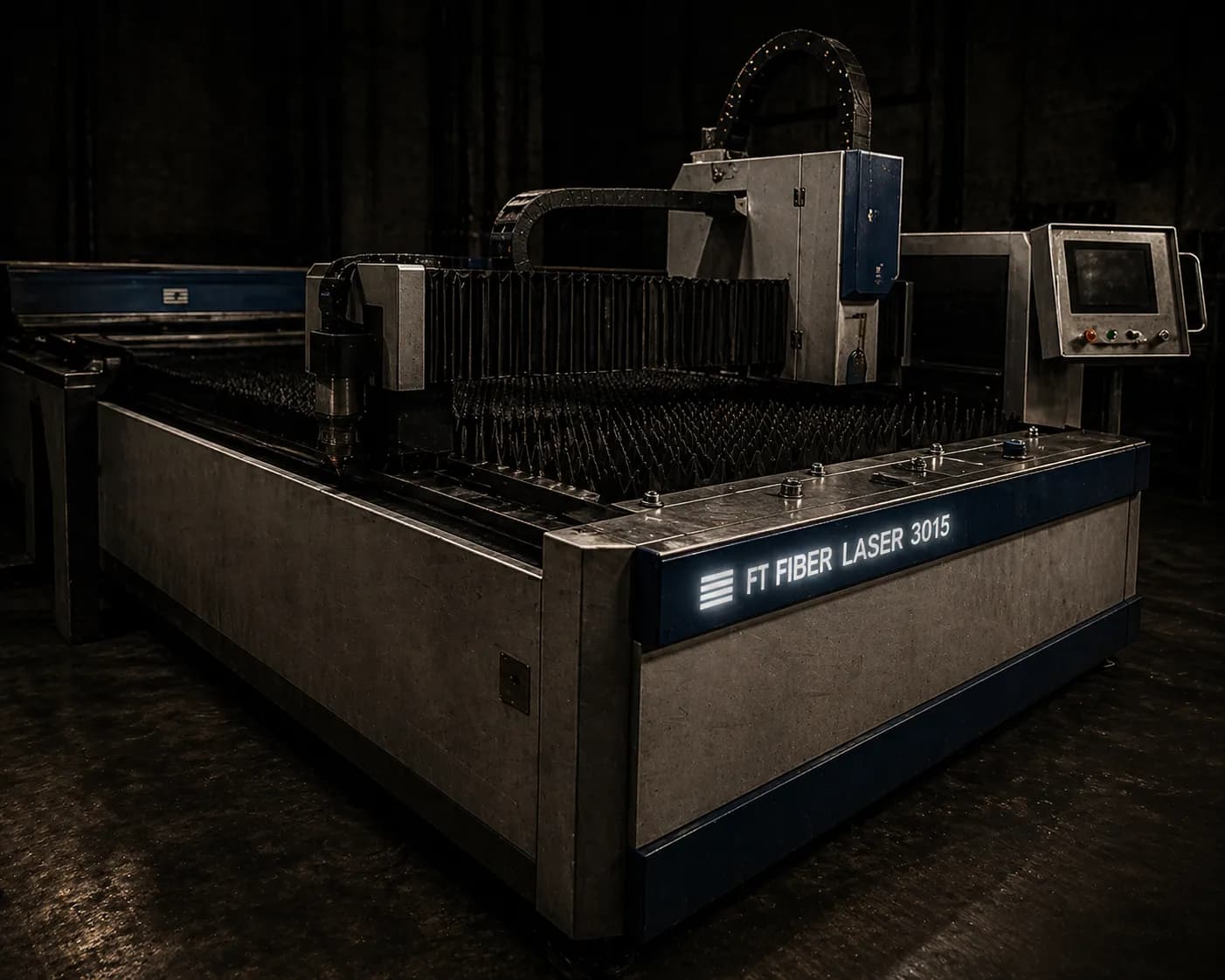
How Sheet Metal Laser Cutting Actually Works and Why the Variables Matter
A fiber laser cutter generates a high-intensity beam through a fiber optic cable seeded by laser diodes and amplified through glass fiber elements. This beam is focused through a cutting head lens onto the sheet metal surface at a focal point small enough to vaporize or melt material along a controlled path defined by CNC G-code derived from your CAD geometry. The cutting head moves across the sheet in two axes while the assist gas, delivered coaxially through the cutting nozzle, clears molten material from the cut zone and controls oxidation at the cut edge. The entire sequence from file to cut part takes minutes on a prepared sheet. The variables that determine whether those parts are dimensionally accurate, have clean edges, and are ready for downstream processes without rework are material condition, focal height, feed rate, laser power, and assist gas type. None of these are visible on a quote sheet. They are process decisions made at the machine level.
Technical Insight
Kerf is the material width removed by the laser beam during cutting. On a fiber laser cutting 2mm mild steel with nitrogen assist, typical kerf width is 0.2 to 0.3mm. This kerf width must be compensated in the cutting file through tool radius offset or the finished part will be undersized by half the kerf value on every cut edge. Fabricators who submit DXF files without kerf compensation instructions to a laser cutting service and expect nominal dimensions on the finished parts are building dimensional error into every component before production starts. The heat-affected zone (HAZ) adjacent to the cut edge is a metallurgically altered region where the base material has been heated above its recrystallization temperature and then cooled rapidly. On thin mild steel below 2mm, HAZ is negligible. On stainless steel above 3mm, HAZ can cause discoloration, hardening, and reduced corrosion resistance at the cut edge that requires post-process finishing.
Why It Matters
At Aero Enterprises Unit I, every laser cutting job begins with a material and file review before the sheet is loaded. Flatness is verified, kerf compensation is confirmed in the cutting file, and assist gas is selected based on the downstream process. Parts going directly to powder coat get nitrogen-assist cutting to produce oxide-free edges. Parts going to welding assembly where edge appearance is secondary get oxygen-assist cutting for higher cutting speed and lower operating cost. These decisions take two minutes at job setup and prevent an hour of edge finishing rework downstream.
Fiber Laser vs CO2 Laser: Why Fiber Has Replaced CO2 in Sheet Metal Fabrication
CO2 lasers use a gas mixture excited by electrical discharge to generate a 10.6 micrometer wavelength beam. They were the dominant laser cutting technology in sheet metal fabrication through the 1990s and 2000s. Fiber lasers generate a 1.06 micrometer wavelength beam, ten times shorter than CO2, which is absorbed significantly more efficiently by metals. This means fiber lasers cut thin and medium sheet metal at two to three times the speed of equivalent-power CO2 machines, consume less electricity per cut meter, require no laser gas consumables, and have a service life exceeding 25,000 hours with minimal maintenance compared to CO2 systems requiring regular gas replenishment and mirror alignment. For sheet metal fabrication in the 0.5mm to 12mm range, fiber laser is the correct technology. CO2 retains an advantage only in cutting non-metals and very thick plate above 20mm where the longer wavelength penetrates more effectively. Any fabricator in 2026 still running CO2 on sheet metal below 10mm is operating at a cost and speed disadvantage.
Assist Gas Selection: Nitrogen vs Oxygen and the Effect on Edge Quality
Assist gas is delivered coaxially through the cutting nozzle and performs three functions: clearing molten metal from the cut zone, cooling the cut edge, and controlling oxidation. Nitrogen is an inert gas. Nitrogen-assist cutting produces a bright, oxide-free edge that accepts powder coat and paint directly without additional edge preparation. It is mandatory for stainless steel to prevent chromium oxide formation, and strongly recommended for any mild steel component going directly to coating without intermediate finishing. Nitrogen consumption is high and nitrogen is a significant operating cost variable in laser cutting. Oxygen is a reactive gas. Oxygen-assist cutting exploits the exothermic reaction between oxygen and hot steel to accelerate cutting speed by 20 to 30 percent on mild steel above 3mm. The trade-off is a dark oxide layer on the cut edge that must be ground or chemically cleaned before powder coat adhesion is reliable. Oxygen-assist is the cost-effective choice for structural mild steel components where cut edges will be welded or are not cosmetically visible. Using oxygen-assist on parts going directly to powder coat is a coating adhesion failure waiting to happen.
Material Preparation for Laser Cutting: Flatness, Grade, and Surface Condition
Laser cutting accuracy degrades directly with sheet flatness deviation. A warped or bowed sheet changes the focal distance between the cutting head and the material surface as the head traverses the sheet. When focal distance changes, the focused spot size increases, cutting power density drops, kerf width varies, and edge quality degrades. The standard flatness requirement for consistent laser cutting results is below 0.1mm deviation per meter. Coils that have been improperly stored, handled, or slitted can exceed this tolerance. Coil set, the natural curve retained after uncoiling, must be levelled before laser cutting. At Aero Enterprises Unit II Dhumal Nagar, all coil stock is processed through levelling before delivery to cutting operations. Surface condition also matters. Oil, scale, moisture, or contamination on the sheet surface affects beam absorption consistency and can cause spattering that damages the cutting lens. Primary mill-certified stock from JSW and TATA arrives with consistent surface condition. Secondary or unverified material requires surface inspection before loading.
Design for Laser Cutting: Rules That Prevent Rework Before It Starts
Minimum hole diameter should be equal to or greater than the material thickness. Cutting a 1mm diameter hole in 2mm sheet requires a hole-to-thickness ratio below 0.5, which produces poor edge quality and frequent piercing failures. Minimum spacing between cut features should be at least twice the material thickness to prevent heat buildup, distortion, and accidental bridging between adjacent cut lines. Holes placed closer than one material thickness to a bend line will deform during bending as the bend draws material inward. Standard recommendation is a minimum hole-to-bend distance of 1.5 times material thickness. Inside corner radii in laser cutting are limited by the beam kerf width, typically 0.1 to 0.15mm minimum, which is effectively a sharp corner for most applications. Sharp outside corners accumulate heat during cutting and can produce small burrs. A 0.5mm radius on outside corners reduces burr formation without affecting part function. Tab-and-slot designs should include a clearance of 0.1 to 0.2mm per side to account for kerf and allow assembly without force-fitting.
Nesting Efficiency: The Cost Lever That Most Fabricators Ignore
Nesting is the process of arranging cut part profiles on a sheet to minimize material waste. On a standard 2500mm by 1250mm sheet, a poorly nested job can waste 30 to 40 percent of the sheet as offcuts and skeleton scrap. A well-nested job using automatic nesting software reduces this to 10 to 15 percent. At current Mumbai mild steel CR pricing of 65 to 72 rupees per kilogram, the material cost difference between 40 percent waste and 15 percent waste on a 100-sheet order is substantial. Most laser cutting services operate on a per-sheet or per-cut-minute billing model. This means poor nesting costs the client material AND machine time. Providing DXF files with accurate part profiles, confirmed kerf allowances, and quantity requirements allows the cutting service to generate an optimized nest. Providing a PDF drawing and asking the cutting service to redraw it before nesting is adding a manual step that introduces dimension errors and costs time. File quality directly affects cut cost.
Laser Cutting vs Shearing vs Turret Punching: Choosing the Right Process
Laser cutting is not always the fastest or cheapest cutting process. For simple rectangular blanks cut to size, mechanical shearing is faster and cheaper per piece because there is no piercing cycle, no nesting complexity, and no assist gas cost. For parts with many repeated simple holes, slots, or formed features in high volume, turret punching is faster than laser cutting because a turret punch hits a feature in a single stroke rather than tracing its outline with a moving laser head. Laser cutting is the correct process for complex geometries, tight tolerances, internal cutouts that cannot be reached by a shear, parts requiring minimal HAZ, low to medium volume runs where tooling investment is not justified, and any geometry that would require multiple shear setups or specialized punching tooling. The process selection decision should be driven by geometry complexity, volume, tolerance requirement, and downstream process requirements, not by which machine is available.
Market Reality
The most common laser cutting problem in Indian fabrication is not machine capability. It is file quality and process ignorance at the client end. Workshops submit PDFs instead of DXF files, drawings without kerf compensation, parts with holes smaller than material thickness, and no indication of downstream process requirements. The laser cutting service makes assumptions to fill the gaps, cuts the job, and delivers parts that are dimensionally off, have oxide edges that reject powder coat, or have holes that deform on bending. The client blames the laser cutting service. The actual failure was at the design and communication stage before the sheet was ever loaded.
At Aero Enterprises Unit I Vasai Phata, our laser cutting intake process includes a mandatory DFM (Design for Manufacturing) check before any job is accepted for production. Every submitted file is reviewed for minimum hole diameter compliance, hole-to-bend spacing, kerf compensation status, and assist gas specification relative to the downstream coating or assembly process. Jobs that fail this check are returned with specific correction notes rather than cut as submitted and returned with defects. This step adds 30 minutes to job setup. It eliminates an average of 4 to 6 hours of rework per batch and prevents material waste on incorrectly cut sheets. Clients who have gone through this process once stop submitting unchecked files.
Get a DFM Review from Aero EnterprisesData and References
- Fiber laser service life exceeds 25,000 hours compared to shorter CO2 system service intervals
- Nitrogen-assist laser cutting produces oxide-free edges suitable for direct powder coat application
- Oxygen-assist cutting increases mild steel cutting speed by 20 to 30 percent at the cost of producing an oxide layer on cut edges
- Standard sheet flatness requirement for consistent laser cutting accuracy is below 0.1mm deviation per meter
- Minimum hole diameter for laser cutting should equal or exceed the material thickness
- Minimum spacing between laser cut features should be at least twice the material thickness to prevent bridging and distortion
- Poor nesting can waste 30 to 40 percent of sheet material versus 10 to 15 percent with optimized automatic nesting
Steel Supply at Unit II Dhumal Nagar
Frequently Asked Questions
What is the difference between fiber laser and CO2 laser for sheet metal?
Fiber laser generates a shorter wavelength beam absorbed more efficiently by metals, cutting thin and medium sheet metal two to three times faster than equivalent CO2 machines while consuming less electricity and requiring no laser gas consumables. CO2 retains an advantage only in cutting non-metals and very thick plate above 20mm. For sheet metal fabrication below 12mm, fiber laser is the correct and more cost-effective technology.
Which assist gas should I specify for laser cutting: nitrogen or oxygen?
Specify nitrogen-assist for stainless steel and for any mild steel component going directly to powder coat or paint, as nitrogen produces an oxide-free edge that accepts coating without additional preparation. Specify oxygen-assist for structural mild steel components going to welding assembly where cut edge appearance is not critical, as it cuts faster and reduces operating cost. Specifying the wrong gas produces either unnecessary operating cost or coating adhesion failures.
What file format should I submit for laser cutting?
Submit DXF files derived from your CAD model, not PDF drawings. DXF files allow the cutting service to import part geometry directly into nesting software with accurate dimensions. PDF drawings require manual redrawing which introduces dimension errors and adds cost. Confirm that kerf compensation is either included in the file or clearly specified as a separate instruction.
What is the minimum hole size for laser cutting in sheet metal?
Minimum hole diameter should equal or exceed the material thickness being cut. A 1mm hole in 2mm sheet produces poor edge quality and frequent piercing failures. Holes below minimum diameter cause inconsistent cut quality, nozzle contamination from spatter, and dimensional inaccuracy on the finished part.
Does Aero Enterprises offer laser cutting with DFM review in Mumbai?
Yes. Aero Enterprises Unit I at Vasai Phata provides fiber laser cutting with a mandatory DFM check on all jobs. Our engineering team reviews hole diameter compliance, hole-to-bend spacing, kerf compensation, and assist gas specification before production. This proactive step prevents dimensional failures, edge oxidation, and raw material waste before the laser ever fires.
When is laser cutting not the right process for sheet metal?
Laser cutting is not the fastest or cheapest option for all sheet metal cutting requirements. For simple rectangular blanks, mechanical shearing is faster and cheaper. For high-volume parts with many repeated simple holes or slots, turret punching is faster because each feature is produced in a single press stroke rather than traced by a moving laser head. Laser cutting is the correct process for complex geometries, tight tolerances, low to medium volume runs, and parts requiring minimal heat-affected zone.
Recommended Technical Reading
What Is Sheet Metal Manufacturing and How Does It Work?
Sheet metal manufacturing is the industrial process of converting flat metal sheets into finished components through cutting, punching, bending, and forming operations. It forms the backbone of electrical enclosures, automotive brackets, HVAC systems, and heavy machinery structures.
Sheet Metal for Fabrication: When to Use HR vs CR vs GI Steel in India
Most fabricators in India default to whatever grade is cheapest or most available on the day of the order. That works until a weld warps, a powder coat delaminates at six months, or a client returns a full batch. The HR vs CR decision is not a price decision. It is a process-matching decision that needs to happen before the first cut, not after the first rejection.
Flood Light Mounting Bracket Manufacturing: Sheet Metal Fabrication Guide
A flood light mounting bracket is one of the most mechanically stressed components in any outdoor lighting installation. It carries the full dead weight of the fixture, absorbs wind load continuously, and sits exposed to UV, rain, and coastal salt air for a service life measured in decades. Most procurement decisions for flood light brackets are made on price per piece. The correct decision is made on material grade, coating system, bend geometry, and fabrication process. A bracket that fails at 18 months in an outdoor installation is not a cheap bracket. It is an expensive one.
Production Infrastructure
20 Power Presses · 3000W Laser · 7-Tank Powder Coat · CNC Bending