L Patti Manufacturing: How Steel Corner Brackets for Furniture Are Made
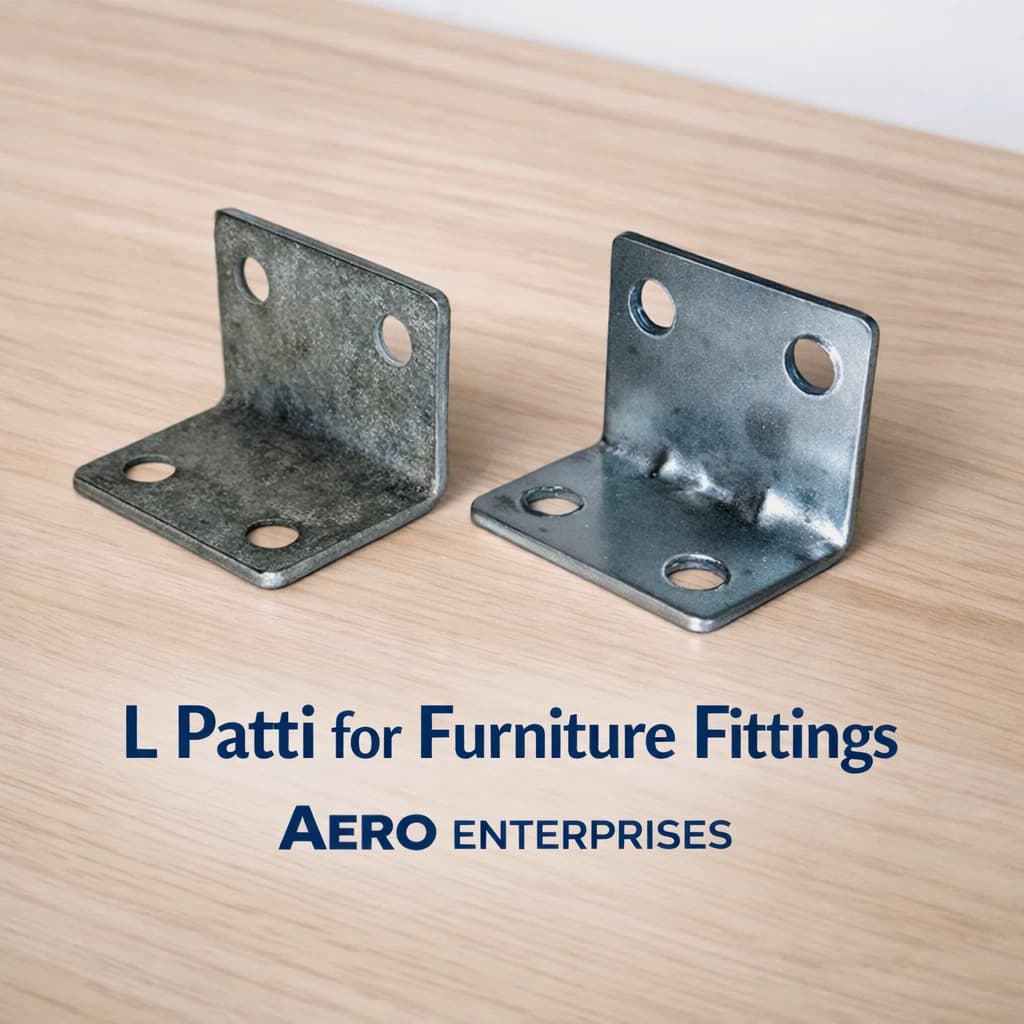
An L patti is one of the most structurally critical components in a wooden furniture assembly and one of the most consistently under-specified. Furniture manufacturers across India source corner brackets on unit price alone, without specifying sheet thickness, hole pattern accuracy, bend radius, or coating system. The result is brackets that deform under joint load, loosen at 12 months, and generate warranty returns that cost multiples of the original hardware saving. At Aero Enterprises Unit I Vasai Phata, L patti corner brackets are manufactured as precision stamped and powder coated structural hardware, not as commodity press shop output.
Aero Enterprises Desk
High-volume mild steel stamping, bending, and powder coat finishing for furniture hardware and structural bracket components
“Content compiled from active L patti corner bracket production at Aero Enterprises Unit I Vasai Phata, processing MS IS 2062 sheet stock through hydraulic power press stamping, CNC press brake bending, and automated powder coat finishing for furniture manufacturers across Mumbai, Thane, and Palghar.”
Last Reviewed: 2026-05-28
Direct Answer
L patti corner brackets for wooden furniture joints are manufactured at Aero Enterprises Unit I Vasai Phata from MS IS 2062 mild steel sheet through a three-stage production sequence: hydraulic power press stamping to produce the flat blank with all mounting holes and profile features, CNC press brake bending to form the 90-degree L profile with consistent angle accuracy, and automated three-stage powder coat finishing with phosphate pretreatment for corrosion resistance and cosmetic consistency.
Quick Summary
- L patti corner brackets are structural furniture hardware components, not commodity stampings
- MS IS 2062 sheet at correct thickness is the only specification for furniture joint brackets that carry repeated dynamic load
- Mounting hole pattern accuracy to plus or minus 0.2mm determines whether the bracket fits the furniture system without pre-loaded stress
- Bend angle accuracy of plus or minus 0.5 degrees on the 90-degree L profile determines joint squareness across the full furniture assembly
- Powder coat without phosphate pretreatment fails on furniture hardware in humid showroom and warehouse storage environments within 12 to 18 months
- Aero Enterprises produces L patti corner brackets at Unit I through stamping, CNC bending, and automated powder coat on the same production floor
Why an L Patti Is a Structural Component, Not a Sheet Metal Commodity
An L patti corner bracket performs three simultaneous mechanical functions in a wooden furniture assembly that are easy to dismiss because the component is small and inexpensive at point of purchase. First, it carries the joint load between two wooden members under static dead weight. A standard wardrobe carcass with shelves loaded at normal household capacity applies a continuous compressive and shear load at every corner joint. The L patti at each corner is the only rigid connection between the two wooden panels. Without it, the joint relies on screws alone in end grain wood, which is the weakest possible wood joint configuration and will loosen progressively under vibration, humidity cycling, and repeated loading. Second, the bracket maintains joint squareness during and after assembly. A 90-degree furniture corner that is not held square by a rigid bracket will rack under side load. Racking produces progressive loosening of all fasteners in the joint as the wood fibers compress and recover around the screw shank with each rack cycle. Third, the mounting holes define the positional relationship between the bracket and the furniture panel drilling pattern. A hole pattern that deviates from nominal by more than 0.3mm forces the assembly operator to either force-fit the bracket, which pre-loads the screws and reduces clamping force, or leave the joint with clearance gaps that reduce load transfer efficiency. None of these mechanical requirements are visible on a unit price quote. They are determined entirely by sheet thickness, hole pattern accuracy, bend angle precision, and coating system at the design and production stage.
Technical Insight
The most common structural failure in furniture corner joints using L patti brackets is not bracket fracture. It is progressive hole elongation under repeated dynamic loading. Every time a drawer is opened and closed, a door is swung, or a loaded shelf deflects under weight, a micro-movement occurs at the bracket mounting holes. If the screw fit in the hole is correct, this micro-movement is absorbed by the clamping friction between the bracket face and the wood surface. If the hole is oversize from worn stamping tooling or undersize from under-maintained punch clearance, the micro-movement is absorbed by the hole edge material, which yields plastically with each cycle and elongates the hole progressively. Elongated holes reduce clamping area, reduce friction, and eventually allow the bracket to move visibly under hand load. At Aero Enterprises Unit I, punch-to-die clearance for mounting holes in L patti brackets is maintained at 10 to 12 percent of material thickness per side and verified on first-off samples at the start of every production run.
Why It Matters
Furniture manufacturers in Mumbai and the wider Maharashtra market who source L patti brackets on unit price without specifying thickness, hole pattern, or coating system are building a warranty liability into every piece of furniture they ship. The unit price difference between a correctly specified 1.5mm MS bracket with phosphate pretreatment powder coat and a commodity 1.0mm bracket with single-coat finish is typically 10 to 18 percent per piece. The warranty return and rework cost when joints loosen at 12 months is multiples of that saving per unit. At Aero Enterprises, every L patti order begins with a joint load application review and a hole pattern verification before production begins.
Stage One: Material Selection for L Patti Brackets at Aero Enterprises Unit II
Every L patti corner bracket produced at Aero Enterprises starts at Unit II Dhumal Nagar where incoming MS IS 2062 coil and sheet stock is received against Mill Test Certificates from JSW or TATA confirming grade, thickness, tensile strength, and chemical composition. MS IS 2062 is the correct base material specification for furniture corner brackets because it provides the tensile strength and ductility required for a bracket that must carry joint load without brittle fracture while remaining formable to a consistent 90-degree profile without cracking at the outer fiber of the bend radius. The correct sheet thickness for L patti brackets depends on the furniture application. For lightweight office furniture, modular shelving, and cabinet carcasses with normal loading, 1.2mm MS IS 2062 is the minimum correct specification. For bedroom furniture, wardrobes, and structural furniture frames carrying higher sustained loads, 1.5mm is the correct specification. For heavy-duty industrial furniture and storage systems, 2.0mm. Specifying 1.0mm to reduce material cost on a bracket that will carry wardrobe loading is a structural failure waiting to happen. The section modulus of a 1.0mm bracket at standard L dimensions is insufficient to carry the combined dead weight and dynamic load of a fully loaded wardrobe without visible deflection at the joint within the first year of service.
Stage Two: Power Press Stamping of the Flat Blank at Unit I
The first production operation at Aero Enterprises Unit I for L patti corner brackets is hydraulic power press stamping of the flat blank. The stamping die produces the complete flat bracket profile including the outer perimeter, all mounting holes, and any countersink or emboss features in a single press stroke or progressive die sequence depending on the order volume. For volumes above 500 pieces per order, progressive die stamping on the hydraulic press floor at Unit I is the correct process because it produces identical blank geometry across every piece in the batch from a continuous coil feed, eliminating the dimensional variation that accumulates in manually loaded single-stroke operations. For volumes below 500 pieces, compound die stamping produces the blank profile and mounting holes simultaneously in a single stroke without requiring the tooling investment of a progressive die. The mounting holes are always stamped in the flat blank before bending. Punching holes in the flat produces clean, consistent hole geometry with correct punch-to-die clearance. Punching holes after bending introduces clearance variation at the punch face due to the formed profile and produces inconsistent hole geometry that affects screw fit and clamping performance in the assembled joint. Every stamping run at Unit I begins with a first-off dimensional check covering hole diameter, hole centre-to-centre spacing, blank overall dimensions, and perimeter profile before batch production is approved.
Stage Three: CNC Press Brake Bending to Form the 90-Degree L Profile
After stamping and first-off verification, the flat blanks move to the CNC press brake at Aero Enterprises Unit I for forming of the 90-degree L profile. The press brake at Unit I operates a 3100mm bed length with a CNC back gauge system that positions each blank against a calibrated mechanical stop before the bend stroke. This produces bend angle repeatability of plus or minus 0.5 degrees across the full bed length. For L patti corner brackets, this angular accuracy is a joint squareness requirement, not a cosmetic tolerance. A bracket bent to 89.5 degrees instead of 90.0 degrees introduces a 0.5-degree angular error at the furniture corner joint. In a wardrobe carcass with four corner joints, four brackets each bent 0.5 degrees out of square produce a cumulative racking error that is visible in the finished assembly as a door gap or panel misalignment. Springback compensation for MS IS 2062 at 1.2mm and 1.5mm is built into the bend program as a material-specific offset derived from production history at Unit I. The first-off bent bracket is verified for angle using a calibrated digital protractor before batch bending is approved. Any angle deviation outside plus or minus 0.5 degrees triggers a bend program adjustment before the batch proceeds. The flange length on both legs of the L is verified against the drawing at first-off using digital calipers. Flange length error directly affects the bracket footprint on the furniture panel and the edge distance from the mounting holes to the bracket perimeter, which determines the minimum safe screw torque before the bracket material yields around the hole.
Stage Four: Deburring Before Powder Coat
After CNC bending, every L patti bracket batch at Aero Enterprises Unit I passes through vibratory deburring before entering the powder coat line. The stamping and piercing operations leave sheared edges at the blank perimeter and mounting hole bores with burr heights of 0.05 to 0.10mm on well-maintained tooling. These burrs are sharp enough to create laceration risk for furniture assembly operators installing brackets by hand and produce thin coating spots at the burr tip that fail first under corrosion exposure in humid storage or showroom environments. Vibratory deburring in an abrasive media tumbler removes burrs uniformly across all sheared edges including the inside of the bent L profile where manual deburring tools cannot reach consistently. After deburring, all bracket edges and mounting hole perimeters are verified for sharpness before the batch moves to the powder coat line. The deburring operation also provides a micro-abraded surface texture on the bracket faces that improves mechanical adhesion of the subsequent powder coat layer, contributing to the coating system performance alongside the chemical adhesion provided by the phosphate pretreatment stage.
Stage Five: Three-Stage Powder Coat Finishing on the Automated Conveyor Line
L patti corner brackets at Aero Enterprises Unit I are finished on the automated powder coat conveyor line through a full three-stage coating system. Stage one is alkaline degreasing and water rinse to remove all stamping lubricants, metal fines, and surface contamination from the bracket body including the inside bend radius and mounting hole bores. Stage two is iron or zinc phosphate conversion coating applied by spray across all bracket surfaces. This stage converts the bare MS surface to a crystalline phosphate structure that provides mechanical and chemical adhesion for the subsequent powder coat layer. For furniture hardware that will spend its service life in showrooms, warehouses, workshops, and occupied homes with variable humidity and temperature, the phosphate conversion coat is the non-negotiable foundation of a coating system that performs for the full furniture service life. Single-coat powder finish applied directly to bare MS steel without phosphate pretreatment relies entirely on mechanical adhesion to the steel surface. In the humidity cycling of a Mumbai monsoon season, a warehouse storage environment, or a coastal showroom, this adhesion fails at cut edges and screw hole perimeters within 12 to 18 months. Stage three is electrostatic polyester powder coat application and oven cure at 180 to 200 degrees Celsius, producing a crosslinked coating at 60 to 80 microns dry film thickness on flat faces and minimum 50 microns on inside bend radii and mounting hole bores. Standard finish colour for L patti brackets is RAL 9005 matt black or RAL 9003 signal white unless the furniture manufacturer specifies an alternative RAL colour with the order. Dry film thickness is measured on every production batch using a calibrated magnetic thickness gauge before dispatch.
Quality Control Sequence for L Patti Brackets at Aero Enterprises Unit I
L patti bracket quality control at Aero Enterprises Unit I covers four sequential verification stages before any batch is dispatched. First-off dimensional check after stamping confirms blank perimeter dimensions, hole diameters, and hole centre-to-centre spacing against the approved drawing before batch stamping begins. Any dimension outside tolerance triggers tooling adjustment before the batch proceeds. First-off angle verification after bending confirms the 90-degree profile is within plus or minus 0.5 degrees and both flange lengths are within plus or minus 0.2mm of nominal before batch bending begins. In-process batch sampling at defined intervals through the stamping and bending runs checks for dimensional drift caused by tooling wear or thermal effects. Burr height is monitored on batch samples after stamping and confirmed within acceptable range before the batch enters deburring. Post-coat dry film thickness measurement on every batch at a minimum of 10 points per bracket covering flat faces, inside bend radius, and mounting hole bore edges confirms coating system integrity before dispatch. Batches failing minimum 50 microns on inside bend radius or hole bore edges are stripped and recoated rather than dispatched with inadequate corrosion protection at the highest-risk surfaces of the bracket.
L Patti Bracket Specifications and Custom Geometry at Aero Enterprises
Aero Enterprises Unit I produces L patti corner brackets across the full range of standard furniture hardware sizes as well as custom geometries specified by furniture manufacturers for proprietary assembly systems. Standard production sizes cover flange lengths from 20mm to 100mm per leg on both equal-leg and unequal-leg configurations. Sheet thickness range is 1.0mm to 3.0mm in MS IS 2062, with 1.2mm and 1.5mm being the standard furniture hardware range. Mounting hole diameters from 4mm to 10mm are standard. Custom hole patterns, additional fixing holes, embossed stiffening ribs, and formed lips or returns are accommodated through in-house die modification at Unit I without external tooling lead time. For volumes above 300 pieces per order, progressive die stamping produces consistent geometry across the batch at lower per-piece cost than individual piece laser cutting and bending. For volumes below 300 pieces or for prototype development of new furniture hardware geometries, single-stroke compound die or laser cut and bend is the correct process route. Contact the Unit I production desk with your drawing, required material thickness, hole pattern, and order volume for an accurate process route and pricing assessment.
Market Reality
The L patti hardware market across Mumbai's furniture manufacturing cluster is almost entirely price-driven. Furniture manufacturers and assembly contractors specify brackets by size and unit cost, with no material thickness specification, no hole pattern tolerance, no bend angle requirement, and no coating system specification. The result is a supply chain full of 1.0mm MS brackets with single-coat powder finish produced from worn stamping tooling that cannot hold hole pattern or bend angle tolerance, dispatched without deburring verification and without coating thickness measurement. These brackets reach the furniture assembly line, get installed by operators who have no time to inspect hardware, and begin creating warranty problems within the first year of service. Joints loosen. Corners rack. Doors misalign. Coating chalks on brackets stored in humid warehouses before assembly. The furniture manufacturer gets the customer complaint. The hardware supplier is already paid. Nobody traces the problem back to a bracket specification that should never have been accepted.
At Aero Enterprises Unit I Vasai Phata, every L patti bracket order is reviewed for four parameters before any production commitment is made. Sheet thickness adequacy for the stated furniture application and load category. Mounting hole pattern tolerance against the furniture system's drilling template. Bend angle requirement against the joint squareness specification of the furniture design. And coating system specification against the storage and installation environment. Furniture manufacturers who arrive with only a size and unit price target are walked through these four parameters before any quote is generated, because a bracket produced without this information is a guess that becomes a warranty problem. Our in-house progressive die capability at Unit I means geometry changes between production runs are handled without external tooling lead time. For furniture manufacturers running high-volume production programs, this means specification refinements between seasons are executed within the same order cycle rather than waiting for new tooling delivery.
Get a DFM Review from Aero EnterprisesData and References
- Minimum correct MS sheet thickness for L patti brackets in wardrobe and bedroom furniture applications is 1.5mm IS 2062
- Mounting hole pattern tolerance for interchangeable bracket systems must be held to plus or minus 0.2mm on centre-to-centre dimensions
- Bend angle repeatability of plus or minus 0.5 degrees on the CNC press brake at Aero Enterprises Unit I is a joint squareness requirement, not a cosmetic tolerance
- Punch-to-die clearance for MS IS 2062 mounting holes is maintained at 10 to 12 percent of material thickness per side at Aero Enterprises Unit I
- Powder coat without phosphate pretreatment fails at cut edges and screw holes in humid furniture storage and showroom environments within 12 to 18 months
- Progressive die stamping is more cost-effective than individual piece processing above 300 to 500 pieces per order
- Dry film thickness specification for powder coat on L patti brackets at Aero Enterprises is 60 to 80 microns on flat faces and minimum 50 microns on inside bend radii and hole bores
Steel Supply at Unit II Dhumal Nagar
Frequently Asked Questions
What is an L patti and what is it used for in furniture manufacturing?
An L patti is a mild steel corner bracket used to reinforce 90-degree joints in wooden furniture assemblies including wardrobes, cabinets, shelving systems, and bed frames. It is installed at the inside corner of the joint where two wooden panels meet, providing a rigid connection that carries joint load, maintains squareness, and prevents the progressive loosening of screw-only end grain wood joints under repeated loading.
What sheet thickness is correct for L patti brackets in furniture applications?
For lightweight office furniture, modular shelving, and low-load cabinet carcasses, 1.2mm MS IS 2062 is the minimum correct specification. For bedroom furniture, wardrobes, and structural furniture frames under normal household loading, 1.5mm is correct. For heavy-duty industrial furniture and high-load storage systems, 2.0mm. Specifying 1.0mm to reduce cost on a wardrobe application produces visible joint deflection and progressive fastener loosening within the first year of service.
Does Aero Enterprises manufacture L patti corner brackets?
Yes. Aero Enterprises manufactures L patti corner brackets at Unit I Vasai Phata from MS IS 2062 certified sheet sourced through Unit II Dhumal Nagar. Production sequence is hydraulic power press stamping, CNC press brake bending to plus or minus 0.5 degree angular accuracy, vibratory deburring, and automated three-stage powder coat finishing with phosphate pretreatment. Standard equal-leg and unequal-leg configurations are available. Custom hole patterns, flange lengths, and RAL colours are accommodated through in-house die modification.
Why does the bend angle matter on an L patti bracket?
The bend angle of an L patti bracket directly determines the squareness of the furniture corner joint it reinforces. A bracket bent to 89.5 degrees instead of 90.0 degrees introduces a 0.5-degree angular error at the furniture corner. In a wardrobe carcass with four corner joints, cumulative angular errors produce visible door misalignment and panel racking. Aero Enterprises CNC press brake bending produces plus or minus 0.5 degree repeatability with springback compensation built into the bend program per material thickness.
What powder coat specification should furniture manufacturers require for L patti brackets?
The correct powder coat system for furniture hardware is two-stage minimum. Stage one is iron or zinc phosphate conversion coat applied after alkaline degreasing. Stage two is polyester powder coat electrostatically applied and oven cured to 60 to 80 microns dry film thickness on flat faces and minimum 50 microns on inside bend radii and hole bores. Single-coat finish without phosphate pretreatment fails at cut edges and screw holes in humid showroom, warehouse, and residential environments within 12 to 18 months.
What is the minimum order quantity for L patti brackets at Aero Enterprises?
For progressive die stamping production, volumes above 300 to 500 pieces per order are cost-effective with existing tooling. Below this threshold, compound die or individual piece processing is used where geometry permits. For custom geometry requiring new die fabrication, tooling cost amortises across the production run and becomes negligible above 2,000 pieces per order. Contact the Unit I production desk with your drawing, thickness, hole pattern, and volume for accurate process route and pricing.
Can Aero Enterprises produce L patti brackets in custom sizes and hole patterns?
Yes. Aero Enterprises Unit I maintains in-house die fabrication and modification capability. Custom flange lengths, unequal-leg configurations, additional mounting holes, non-standard hole diameters, embossed stiffening ribs, and formed lips or returns are accommodated without external tooling lead time. Geometry changes between production runs for repeat orders are handled within the same order cycle. Provide your DXF file or dimensioned drawing, required thickness, and volume to the Unit I production desk for a process route and pricing assessment.
What RAL colours are available for L patti brackets at Aero Enterprises?
Standard production colours held in regular stock include RAL 9005 matt black, RAL 9003 signal white, RAL 7035 light grey, and RAL 6005 moss green. Non-standard RAL colours are available with a minimum order quantity and colour change lead time on the automated powder coat conveyor line at Unit I. All colour batches are verified against a calibrated reference panel before dispatch to ensure colour consistency across multi-batch furniture production programs.
Recommended Technical Reading
Flood Light Mounting Bracket Manufacturing: Sheet Metal Fabrication Guide
A flood light mounting bracket is one of the most mechanically stressed components in any outdoor lighting installation. It carries the full dead weight of the fixture, absorbs wind load continuously, and sits exposed to UV, rain, and coastal salt air for a service life measured in decades. Most procurement decisions for flood light brackets are made on price per piece. The correct decision is made on material grade, coating system, bend geometry, and fabrication process. A bracket that fails at 18 months in an outdoor installation is not a cheap bracket. It is an expensive one.
From Flat Sheet Metal to Precision Component: How Aero Enterprises Does It
A flat sheet of mild steel sitting in the stockyard at Aero Enterprises Unit II Dhumal Nagar has no value to a client. The value is created at Unit I Vasai Phata, where that sheet goes through a defined sequence of power press stamping, CNC bending, and punching operations to become a finished precision component that fits a specific assembly, carries a specific load, and meets a specific dimensional tolerance. That transformation is not a series of independent steps. It is a production system. Understanding how that system works, what each process contributes, and where the failure points are is the difference between a client who gets consistent precision parts and one who gets consistent rejections.
Production Infrastructure
20 Power Presses · 3000W Laser · 7-Tank Powder Coat · CNC Bending