How Saddle Pipe Clamps Are Made Using Power Press Stamping
A saddle pipe clamp manufactured in the Mumbai and Vasai industrial corridor looks like one of the simplest components in any building or industrial installation. A U-shape bend, two mounting holes, a painted or galvanized finish. Most procurement decisions treat it exactly that way, a commodity item bought on price per piece with no specification depth. That approach works until a clamp deforms under pipe weight, corrodes through at 18 months in a wet riser shaft, or pulls away from the wall because the mounting hole punched undersized for the fastener. At Aero Enterprises Unit I Vasai Phata, saddle pipe clamps are not treated as commodity stampings. They are treated as structural hardware components where the die geometry, material grade, hole pattern accuracy, and coating system determine whether the clamp performs for 10 years or fails at 18 months.
Aero Enterprises Desk
High-volume power press stamping of MS and GI pipe clamps, saddle hardware, and structural support components for plumbing, HVAC, and electrical conduit applications
“Content compiled from active saddle pipe clamp stamping operations at Aero Enterprises Unit I Vasai Phata, processing JSW and TATA certified MS and GI coil stock through hydraulic power presses with compound and progressive dies to produce U-shape saddle clamps for plumbing, HVAC ducting support, and electrical conduit applications across Mumbai, Thane, and Palghar.”
Last Reviewed: 2026-05-26
Direct Answer
Saddle pipe clamps are manufactured at Aero Enterprises Unit I Vasai Phata using a hydraulic power press with compound or progressive dies that blank the flat strip, pierce the mounting holes, and form the U-shape saddle profile in a single controlled press sequence. MS IS 2062 and GI IS 277 coil stock sourced from JSW and TATA through Unit II Dhumal Nagar are the base materials. Finished clamps are either powder coated for MS grade or supplied with the factory GI zinc coating for galvanized grade.
Quick Summary
- Aero Enterprises produces U-shape saddle pipe clamps at Unit I Vasai Phata using hydraulic power press stamping on MS and GI certified coil stock
- The complete clamp profile including U-form and mounting holes is produced in a single compound or progressive die press sequence
- MS clamps undergo automated three-stage powder coating at Unit I with zinc phosphate pretreatment and 60-80 micron DFT
- GI clamps are supplied with factory zinc coating and require post-weld zinc repair only where welding is specified
- Material grade selection between MS and GI is determined by installation environment, not unit price
- Mounting hole diameter tolerance is a critical specification, not a secondary dimension
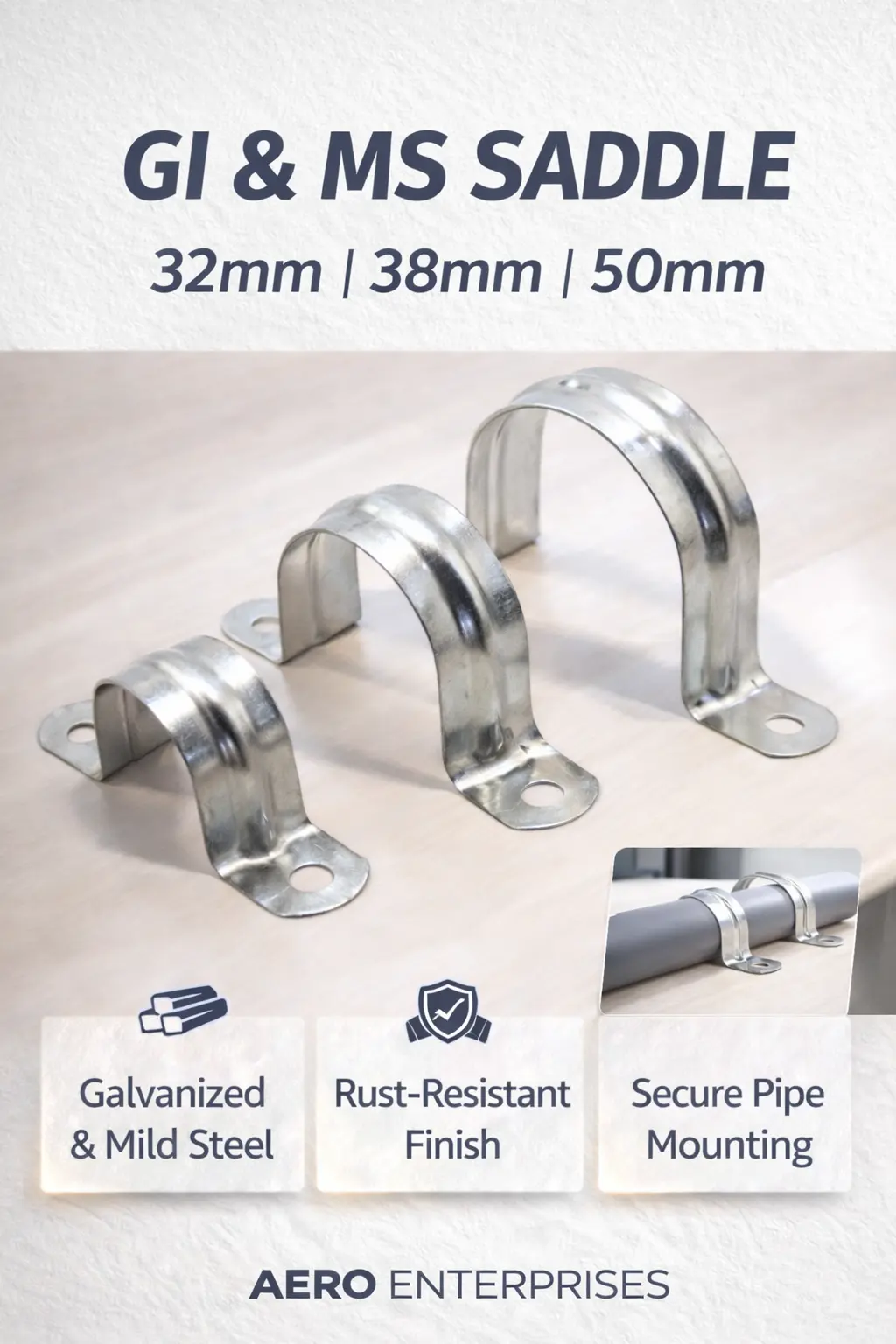
Why Saddle Pipe Clamp Quality Is Determined at the Press, Not at Inspection
A U-shape saddle pipe clamp performs three simultaneous mechanical functions that are easy to dismiss because the component is small and inexpensive at point of purchase. First, it carries the continuous static dead weight of the pipe it supports, including the weight of the fluid or gas inside the pipe under operating conditions. A 50mm diameter water pipe running full weighs approximately 2.5 kilograms per meter. A run of 10 meters supported at 1.5 meter centres applies a continuous load of approximately 1.7 kilograms per clamp. Multiply this across a riser shaft with 20 floors and the cumulative load on the lower clamps includes the pipe dead weight plus thermal expansion forces as the pipe heats and cools through daily operating cycles. Second, the clamp maintains pipe position under vibration. In HVAC and conduit applications, compressor vibration and fluid flow pulsation create dynamic loads that cycle the clamp through thousands of load reversals per day. A clamp with a U-form radius too tight for the pipe OD creates line contact rather than saddle contact, concentrating all load on two narrow lines rather than distributing it across the full contact arc. This contact stress concentration accelerates fatigue failure at the bend radii. Third, the mounting holes provide the entire load path between the clamp and the wall or structure. A mounting hole punched undersized relative to the fastener creates a force-fit condition that expands the hole edge plastically on installation. The expanded edge has reduced bearing area for the fastener head or washer, which increases contact stress and accelerates loosening under vibration. At Aero Enterprises Unit I, the U-form radius for every saddle clamp die is specified to match the pipe OD it is designed for plus a clearance of 0.5 to 1.0mm to ensure full saddle contact rather than line contact. Mounting hole diameters are specified at fastener diameter plus 0.15mm clearance. These two parameters are verified on every first-off sample before batch production is approved.
Technical Insight
The forming quality of a U-shape saddle clamp is determined entirely by die geometry and press force control. The U-form die at Aero Enterprises Unit I uses a matched punch radius and die cavity radius calculated to produce the specified inside radius after springback. Springback in MS IS 2062 at 2.5mm thickness opens the formed angle by approximately 2 to 4 degrees after the punch retracts. The die geometry compensates for this springback by over-bending to the calculated angle so that the spring-open brings the clamp to the correct final U-profile that matches the pipe OD. A die designed without springback compensation produces clamps that are either too tight on the pipe, requiring force-fitting that scores the pipe surface, or too loose, producing gap contact that reduces load distribution and allows the pipe to shift under vibration. Both conditions are invisible in a visual inspection of the finished clamp and only manifest in service.
Why It Matters
Procurement teams in plumbing, HVAC, and electrical contracting in Mumbai who source saddle pipe clamps on unit price without specifying material grade, wall thickness, U-form radius, or coating system are creating a maintenance liability that hits the project in year one or two of service. The unit price difference between a correctly specified MS clamp with a three-stage powder coat system and a commodity single-coat clamp produced from unverified secondary strip is typically 8 to 15 percent per piece. The replacement and reinstallation cost when commodity clamps fail in a concealed riser shaft or above a suspended ceiling is multiples of the original order value. At Aero Enterprises, every saddle clamp order is reviewed for pipe OD compatibility, installation environment, and coating system before production begins.
Stage One: Raw Material Selection at Aero Enterprises Unit II Dhumal Nagar
Every saddle pipe clamp produced at Aero Enterprises starts at Unit II Dhumal Nagar where incoming coil stock is received against Mill Test Certificates from JSW or TATA. MS IS 2062 coil strip is the base material for clamps destined for powder coat finishing in sheltered, indoor, or semi-exposed environments including internal plumbing risers, HVAC plant rooms, and electrical conduit runs in commercial buildings. GI IS 277 coil strip is the base material for clamps in outdoor, wet, or corrosion-aggressive environments including external pipe runs, underground service trenches, coastal infrastructure, and any installation where re-coating in service is not practical. The zinc coating on GI IS 277 at 120 GSM minimum for standard applications and 180 GSM for coastal or high-humidity environments provides sacrificial corrosion protection that continues even when the zinc surface is mechanically scratched during installation. Substituting MS strip for a GI-specified application to reduce material cost removes this protection entirely. The corrosion that results is not a surface cosmetic issue. It is section loss at the clamp body that reduces load-carrying capacity and eventually causes structural failure of the pipe support. The coil thickness specification for saddle clamps at Aero Enterprises Unit I ranges from 2.0mm for small bore clamps supporting pipes up to 25mm OD to 3.0mm for large bore clamps supporting pipes from 50mm to 100mm OD. Thickness below this range for the given pipe size reduces the section modulus of the clamp body below the load requirement.
Stage Two: Blanking the Clamp Strip at the Power Press
The first operation in saddle pipe clamp production at Aero Enterprises Unit I is blanking the flat strip to the developed length required for the U-form plus mounting flanges. The developed length of a saddle clamp is not simply the pipe circumference. It is the pipe half-circumference for the U-form arc plus the two straight flange legs plus the bend allowance compensation for material stretching at the U-form transition. Incorrect developed length produces a clamp where the mounting flanges are either too short to provide adequate fastener edge distance or too long, creating assembly interference with adjacent structure. The blanking die at Unit I produces strips to the correct developed length for each pipe OD class from the incoming coil stock in a single press stroke. Blanking from coil strip rather than from pre-cut sheets allows continuous production without manual blank loading between strokes, which increases throughput and eliminates the positional variation that manual loading introduces. Blank width is also controlled at the blanking stage. Blank width determines the saddle depth, which is the contact arc length between the clamp and the pipe surface. Insufficient saddle depth reduces contact area and increases contact stress on the pipe wall, which accelerates wear on plastic-coated pipes and causes indentation marks on copper tube. At Aero Enterprises, saddle depth for each pipe OD class is specified and verified on first-off samples against the pipe compatibility requirement.
Stage Three: Piercing Mounting Holes at the Power Press
Mounting holes in saddle pipe clamps at Aero Enterprises Unit I are pierced in the flat blank before U-form bending. Piercing in the flat blank produces cleaner hole geometry with consistent edge condition compared to piercing through a formed section after bending, because the flat blank presents a uniform die clearance across the punch face. The punch-to-die clearance for piercing MS IS 2062 at 2.5mm is maintained at 10 to 12 percent of material thickness per side at Unit I. Below this clearance, secondary shear produces a rough, torn hole edge that creates stress concentration around the fastener bearing area. Above this clearance, the material rolls into the die opening before shearing, producing a dished entry and excessive exit burr. Both conditions reduce fastener bearing area and accelerate hole elongation under vibration loading in service. Hole diameter is specified at fastener diameter plus 0.15mm clearance for M6 and M8 fasteners, which are the standard fixing sizes for saddle clamps in plumbing and HVAC applications. Hole centre-to-centre spacing and edge distance from the blank perimeter are held to plus or minus 0.2mm from nominal. These are not secondary dimensions. They determine whether the clamp aligns correctly with the pre-drilled hole pattern on standard strut channel and pipe support brackets used in mechanical and electrical installation systems across India.
Stage Four: U-Form Stamping on the Hydraulic Power Press
The U-form bending operation is the defining process step in saddle pipe clamp production at Aero Enterprises Unit I. The flat blank with pierced mounting holes is positioned in the U-form die and the hydraulic press descends, driving the punch into the die cavity to form the U-shape saddle profile in a single controlled press stroke. The U-form punch radius at Unit I is specified for each pipe OD class and accounts for springback in the specific material grade and thickness being processed. MS IS 2062 at 2.5mm requires a springback compensation of approximately 3 degrees in the die angle to produce the correct final radius after press release. GI IS 277 at the same thickness requires a slightly different compensation because the zinc coating and the base steel have different elastic moduli, which changes the springback behaviour marginally. These differences are built into separate die sets for MS and GI production at Unit I rather than estimated at the press by the operator. The hydraulic press provides controllable forming force across the full stroke depth, which is the correct press type for U-form saddle clamps because the forming force requirement increases as the punch deepens into the die cavity. A mechanical press with fixed stroke energy can under-form a clamp at the bottom of the stroke if the material resistance exceeds the available press energy at that stroke position. A hydraulic press maintains programmable force through the full stroke regardless of resistance variation, producing consistent U-form depth and radius across every piece in the batch.
Stage Five: Deburring and Edge Finishing Before Coating
After stamping and U-form forming, every saddle pipe clamp batch at Aero Enterprises Unit I passes through vibratory deburring before entering the finishing line. The stamping and piercing operations leave sheared edges at the blank perimeter, mounting hole edges, and the flange cut ends with burr heights of 0.05 to 0.10mm on well-maintained tooling. These burrs are sharp enough to create laceration risk for installation crews and produce thin coating spots at the burr tip that fail first under corrosion exposure in wet or humid installation environments. Vibratory deburring at Unit I tumbles the clamp batch in an abrasive media bowl to remove burrs uniformly across all sheared edges including the inside of the U-form where manual deburring cannot reach consistently. After deburring, all clamp perimeter edges and mounting hole edges are verified for sharpness before the batch moves to finishing. GI clamps exit the deburring stage ready for dispatch since the factory zinc coating is already the corrosion protection system. MS clamps exit deburring and enter the powder coat line.
Stage Six: Powder Coat Finishing for MS Saddle Clamps at Aero Enterprises Unit I
MS saddle pipe clamps produced at Aero Enterprises Unit I are finished on the automated powder coat conveyor line through a full three-stage coating system. Stage one is alkaline degreasing and water rinse to remove stamping lubricants, metal fines, and surface contamination from the clamp body including the inside of the U-form and mounting hole bores. Stage two is iron or zinc phosphate conversion coating applied by spray across all clamp surfaces, converting the bare MS surface to a crystalline phosphate structure that provides mechanical and chemical adhesion for the subsequent powder coat. This stage is not optional for saddle clamps going into plumbing riser shafts, HVAC plant rooms, or conduit installations in Mumbai's humidity range. Without the conversion coat, powder coat adhesion on the inside of the U-form and at the punched hole edges relies entirely on mechanical bonding to bare steel, which fails under condensation cycling and cleaning chemical exposure within 12 to 18 months. Stage three is electrostatic polyester powder coat application and oven cure at 180 to 200 degrees Celsius, producing a crosslinked coating at 60 to 80 microns dry film thickness on external clamp faces. Inside U-form radius and mounting hole bore thickness is verified at a minimum of 50 microns to confirm adequate edge and inside-surface coverage. Standard finish colour is RAL 9005 matt black for MS saddle clamps unless the client specifies an alternative RAL colour with the order.
GI Saddle Clamps: Where the Zinc Coating Does the Work and Where It Does Not
GI IS 277 saddle clamps produced at Aero Enterprises Unit I leave the press and deburring stage with the factory zinc coating as the complete corrosion protection system. No additional powder coat is applied unless specifically requested by the client. The zinc coating on the GI base strip provides sacrificial protection that corrodes preferentially to the base steel, protecting it even when the zinc surface is cut, scratched, or abraded during installation. This makes GI saddle clamps the correct specification for outdoor pipe runs, underground service trenches, external HVAC riser brackets, and any installation in Mumbai's coastal humidity belt where long-term maintenance access is limited. The one critical limitation of GI saddle clamps is cut edge exposure. When the blanking die shears through the GI strip, the cut edge exposes a thin section of bare MS base steel with no zinc coating. This cut edge is the most vulnerable corrosion point on a GI saddle clamp. In standard sheltered installations, the cut edge area is small relative to the total clamp surface and the zinc on adjacent faces provides cathodic protection that slows cut edge corrosion significantly. In highly aggressive environments such as direct seawater splash zones or chemical process areas, cut edge corrosion can progress faster than the adjacent zinc sacrificial protection can compensate. For these environments, a zinc-rich cold galvanizing spray applied to cut edges after stamping provides the correct protection. Aero Enterprises applies cut-edge zinc-rich treatment on GI saddle clamps where the client specifies aggressive environment installation.
Market Reality
The saddle pipe clamp market across Mumbai's mechanical, plumbing, and electrical contracting sector is almost entirely price-driven. Contractors specify clamps by pipe OD compatibility and unit cost. No material grade. No wall thickness. No coating system. No hole pattern tolerance. The result is job sites receiving MS clamps with single-coat powder finish and no conversion coat pretreatment, stamped from secondary unverified strip on worn tooling that cannot hold hole pattern or U-form radius tolerance, dispatched without deburring. These clamps reach site, get installed by a labour team that does not inspect hardware components, and begin failing within the first year. U-forms that are too tight score copper tube surfaces. Mounting holes that are oversized from worn tooling allow fastener movement under vibration. Powder coat that delaminates at 12 months in a wet riser shaft leaves bare MS exposed to continuous condensation. The MEP contractor gets the punch-list item. The clamp supplier is already paid. The replacement cost plus access cost in a concealed riser shaft is 20 to 50 times the original clamp unit price.
At Aero Enterprises Unit I Vasai Phata, every saddle pipe clamp order is reviewed for four parameters before any production begins. Pipe OD compatibility to confirm the U-form die produces the correct radius with full saddle contact rather than line contact. Material grade against the installation environment description provided by the client. Mounting hole diameter and pattern against the fixing system being used on site. And coating system against the access and maintenance conditions of the installation. Clients who arrive with only a pipe size and a unit price target are walked through these four parameters before any quote is generated, because a clamp produced without this information is a guess that becomes a site defect. Our in-house die maintenance at Unit I means U-form radius and hole pattern geometry is verified on first-off samples at the start of every production run, not assumed to be correct because the same die ran correctly last month. Die wear is real. Tooling verification is not optional.
Get a DFM Review from Aero EnterprisesData and References
- A 50mm diameter water pipe running full weighs approximately 2.5 kilograms per meter, generating continuous static load on every support clamp in the run
- U-form punch radius must compensate for springback of approximately 3 degrees in MS IS 2062 at 2.5mm thickness to produce the correct final inside radius after press release
- Mounting hole diameter for saddle clamps is specified at fastener diameter plus 0.15mm clearance to prevent force-fit plastic deformation of the hole edge on installation
- Punch-to-die clearance for piercing MS IS 2062 at 2.5mm is maintained at 10 to 12 percent of material thickness per side at Aero Enterprises Unit I
- GI IS 277 at 120 GSM minimum for standard applications and 180 GSM for coastal or high-humidity installations is the correct zinc coating specification for outdoor saddle clamps
- Powder coat dry film thickness on inside U-form radius must be verified at minimum 50 microns to ensure adequate corrosion protection at the highest-risk contact surface
- Replacement and access cost for failed clamps in a concealed riser shaft is 20 to 50 times the original clamp unit price
Steel Supply at Unit II Dhumal Nagar
Frequently Asked Questions
What is a saddle pipe clamp and how is it made?
A saddle pipe clamp is a U-shape sheet metal component that supports and restrains pipes against a wall or structure. At Aero Enterprises Unit I Vasai Phata, it is manufactured from MS IS 2062 or GI IS 277 certified coil stock through a power press stamping sequence that blanks the flat strip to developed length, pierces mounting holes in the flat blank, and forms the U-shape saddle profile in a single hydraulic press stroke using a springback-compensated die. MS clamps are powder coated on the automated conveyor line. GI clamps are supplied with the factory zinc coating.
What is the difference between MS and GI saddle pipe clamps?
MS IS 2062 saddle clamps are the correct specification for indoor, sheltered, and semi-exposed environments where powder coat finishing provides adequate corrosion protection. GI IS 277 saddle clamps are the correct specification for outdoor pipe runs, wet environments, coastal installations, and any application where long-term maintenance access is limited, because the factory zinc coating provides sacrificial corrosion protection that continues even when mechanically damaged during installation.
Does Aero Enterprises manufacture saddle pipe clamps in Mumbai?
Yes. Aero Enterprises manufactures U-shape saddle pipe clamps at Unit I Vasai Phata using hydraulic power press stamping on JSW and TATA certified MS IS 2062 and GI IS 277 coil stock. MS clamps are finished on the automated three-stage powder coat conveyor line at Unit I. GI clamps are supplied with factory zinc coating. All orders begin with a pipe OD compatibility and installation environment review before production begins.
Why does U-form radius matter in a saddle pipe clamp?
U-form radius determines whether the clamp makes full saddle contact with the pipe across the arc or line contact at two narrow points. Full saddle contact distributes pipe load across the complete contact arc, minimising contact stress on the pipe wall and clamp body. Line contact from an incorrect radius concentrates all load on two points, accelerating fatigue failure at the clamp bend radii and causing indentation marks on copper or plastic-coated pipes.
What pipe sizes does Aero Enterprises manufacture saddle clamps for?
Aero Enterprises Unit I produces saddle pipe clamps for standard pipe OD classes from 15mm to 100mm diameter covering standard plumbing, HVAC, and electrical conduit pipe sizes used across the Mumbai industrial and commercial construction market. Custom pipe OD classes outside this range are accommodated through die modification at Unit I. Contact the Unit I sales desk with your pipe OD, material requirement, and order volume for an accurate quote.
What coating specification should I require for saddle clamps in a wet riser shaft?
For MS saddle clamps in a wet riser shaft, the correct coating specification is a full three-stage powder coat system including alkaline degreasing, zinc or iron phosphate conversion coat, and polyester top coat at minimum 60 microns dry film thickness on external faces and 50 microns on inside U-form radius. A single-coat powder finish without conversion coat pretreatment will delaminate in the wet, humid environment of a plumbing riser shaft within 12 to 18 months. For direct water splash or external installation in Mumbai's coastal belt, GI IS 277 at 180 GSM is the correct base material specification.
Recommended Technical Reading
What Is Sheet Metal Manufacturing and How Does It Work?
Sheet metal manufacturing is the industrial process of converting flat metal sheets into finished components through cutting, punching, bending, and forming operations. It forms the backbone of electrical enclosures, automotive brackets, HVAC systems, and heavy machinery structures.
Sheet Metal Laser Cutting: The Complete Guide for Indian Fabricators
Laser cutting is the most precise sheet metal cutting process available in industrial fabrication today. But precision is only as useful as the decisions made before the laser fires: material grade, sheet flatness, kerf compensation, assist gas selection, and nesting efficiency. Fabricators who treat laser cutting as a commodity service and ignore these variables are paying for precision they are not actually receiving.
Sheet Metal for Fabrication: When to Use HR vs CR vs GI Steel in India
Most fabricators in India default to whatever grade is cheapest or most available on the day of the order. That works until a weld warps, a powder coat delaminates at six months, or a client returns a full batch. The HR vs CR decision is not a price decision. It is a process-matching decision that needs to happen before the first cut, not after the first rejection.
Production Infrastructure
20 Power Presses · 3000W Laser · 7-Tank Powder Coat · CNC Bending